A Practical Guide to Post-Quantum Cryptography Migration
A staged approach to cryptographic discovery, quantum-risk prioritization, protocol testing, hybrid deployment, supplier coordination, and safe rollback.
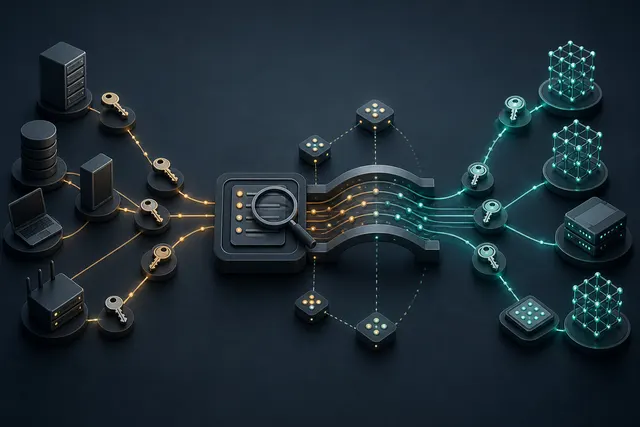
Post-quantum migration is not an instruction to replace every cipher immediately. It is a programme for finding where public-key cryptography supports confidentiality, identity, software trust, and recovery; deciding which uses will become risky first; and changing them without breaking the systems they protect.
That distinction prevents two expensive mistakes. Waiting for a precise prediction of a cryptographically relevant quantum computer leaves no time for procurement, protocol changes, hardware replacement, and certificate turnover. Replacing algorithms without understanding their context can create outages or weaker implementations long before a quantum adversary exists.
Start with the threat that actually changes
A sufficiently capable quantum computer would threaten widely used public-key systems based on integer factorization and discrete logarithms, including RSA and elliptic-curve cryptography. These mechanisms are used for key establishment and digital signatures. The effect is not identical for every cryptographic function.
Bulk data is normally protected with symmetric encryption after a public-key exchange establishes a session key. Hash functions and symmetric algorithms are also affected by quantum algorithms, but they do not fail in the same way as RSA or elliptic-curve systems. Migration planning should therefore identify the function being performed rather than search only for familiar algorithm names.
NIST finalized its first three principal post-quantum standards in 2024: FIPS 203 for ML-KEM, FIPS 204 for ML-DSA, and FIPS 205 for SLH-DSA. ML-KEM is a key-encapsulation mechanism for establishing shared secrets. ML-DSA and SLH-DSA provide digital signatures. They are different tools, not interchangeable labels for “quantum-safe encryption.”
Treat time as a property of the data
The most immediate quantum-related confidentiality problem is often called harvest now, decrypt later. An adversary can store encrypted traffic or archives today and attempt to decrypt them if a capable machine becomes available later. The relevant question is not simply when that machine might exist. It is whether the information must remain confidential beyond the combined time needed to migrate and the remaining safe lifetime of the current cryptography.
Long-lived health, government, research, identity, legal, or industrial information can deserve earlier action than short-lived operational data. Digital signatures have a different timeline. A signature may need to remain trustworthy for software-update chains, device firmware, documents, certificates, audit records, or code that will be validated years later.
Create risk classes that include:
- confidentiality lifetime and retention obligations;
- how long a system or device will remain deployed;
- the consequences of forged identity, code, firmware, or records;
- exposure to passive collection now;
- replacement lead time for hardware, protocols, suppliers, and certificates;
- whether a safe upgrade and rollback path already exists.
“Quantum risk” should become a prioritization field in an existing asset and data-risk process, not a separate list owned only by cryptographers.
Build a cryptographic inventory that follows dependencies
An asset inventory says that a server, application, device, or service exists. A useful cryptographic inventory says where and why cryptography is used, which component controls it, what keys and certificates depend on it, and what else must change with it. The joint CISA, NSA, and NIST quantum-readiness guidance recommends early discovery and supplier engagement because migration crosses information technology, operational technology, and procurement.
For each use, record at least:
- protocol, library, provider, algorithm, parameter set, and configuration;
- purpose: key establishment, signature, authentication, certificate issuance, storage, or another function;
- key location, ownership, rotation process, and hardware dependency;
- data classification and required protection lifetime;
- producer, verifier, peers, certificate authorities, and trust anchors;
- software, firmware, network, device, and supplier dependencies;
- supported alternatives, negotiation behavior, and downgrade rules;
- test owner, migration owner, maintenance window, and rollback method.
Discovery tools can inspect configurations, source code, binaries, traffic, certificates, key stores, hardware modules, package dependencies, and cloud services. None sees the whole estate. NIST’s current migration FAQ organizes its work around cryptographic visibility and risk management plus interoperability and benchmarking, reinforcing that discovery and deployment testing are separate workstreams. Compare tool output with architecture records, procurement data, certificate inventories, code search, runtime observation, and interviews. Record blind spots rather than converting “not detected” into “not present.”
Prioritize systems, not algorithm counts
A thousand low-impact development certificates may be less urgent than one signing key that authorizes firmware across a long-lived device fleet. Rank migration units by consequence and dependency depth, not by how many instances a scanner finds.
A practical first wave often includes:
- data whose confidentiality must survive for many years;
- roots of trust and signing systems with long validation periods;
- products with long procurement or field-service cycles;
- shared platforms whose upgrade unlocks many dependent applications;
- internet-facing protocols where interoperability can be tested safely;
- systems already approaching a scheduled replacement.
Maintain an exception register for systems that cannot yet migrate. It should identify the owner, reason, compensating controls, supplier commitment, next review date, and retirement plan. “Unsupported” is a risk decision, not a permanent status.
Design for crypto agility before choosing a switch date
NIST defines crypto agility as the capability to replace and adapt cryptographic algorithms across protocols, applications, software, hardware, firmware, and infrastructure while preserving security and operations. It does not mean accepting arbitrary algorithms at runtime.
Useful agility has controlled choices:
- versioned algorithm and parameter identifiers;
- policy that separates allowed, preferred, deprecated, and forbidden options;
- keys bound to their algorithm, purpose, environment, and lifecycle;
- independently updateable crypto providers where architecture permits;
- telemetry for negotiation, failures, fallbacks, and deprecated use;
- test vectors and compatibility suites for every supported combination;
- signed configuration, change control, and a rehearsed rollback path.
Avoid scattering algorithm names and key sizes through business logic. Also avoid a universal abstraction that hides security-relevant differences. A key-encapsulation mechanism is not a drop-in signature scheme, and a larger signature or public key can change message size, memory, latency, certificate chains, hardware interfaces, and denial-of-service exposure.
Test protocols, not just primitive implementations
Passing an algorithm test vector proves only a narrow mathematical implementation result. Secure deployment also depends on randomness, key generation, validation, error handling, protocol binding, authentication, side-channel resistance, and lifecycle controls. NIST SP 800-227 describes properties and secure-use recommendations for key-encapsulation mechanisms; implementers still need a protocol that uses the established secret correctly.
Build tests around real boundaries:
- maximum handshake, certificate, signature, and message sizes;
- fragmentation, packet loss, proxies, inspection devices, and constrained links;
- CPU, memory, latency, and concurrency under normal and hostile load;
- old clients, old firmware, middleboxes, hardware security modules, and backup systems;
- malformed keys, ciphertexts, signatures, and negotiation messages;
- downgrade attempts and silent fallback;
- certificate issuance, renewal, revocation, archival validation, and disaster recovery;
- key destruction and restoration from approved backups.
Measure both peers. A service that supports a new algorithm is not migrated if important clients never negotiate it, verifiers reject its signatures, or monitoring cannot distinguish success from fallback.
Understand what “hybrid” means
During a transition, a system may combine a traditional algorithm with a post-quantum algorithm. RFC 9794 defines terminology for post-quantum/traditional hybrid schemes and protocols. The intended benefit is resilience when the construction remains secure as long as at least one suitable component remains secure.
Merely advertising either a traditional or post-quantum option is not the same as combining them. Concatenating outputs without a reviewed combiner is not automatically safe. Hybrid designs can increase message sizes, implementation paths, key-management work, and failure modes. Use combinations specified by the protocol and supported by maintained implementations; do not invent an organization-specific cryptographic composition.
A hybrid stage can reduce transition risk, but it is a stage with an exit plan. Otherwise the estate can retain the cost and attack surface of both systems indefinitely.
Run the migration as evidence-producing waves
Each wave should have a defined population, success criteria, observation period, and rollback trigger. A defensible sequence is:
- Discover: establish coverage, ownership, dependencies, and known blind spots.
- Classify: apply data lifetime, authenticity impact, system lifetime, and replacement lead time.
- Prepare: update architecture, procurement requirements, providers, telemetry, and test environments.
- Pilot: choose bounded systems with representative protocol and operational constraints.
- Expand: migrate by dependency group, not isolated host counts.
- Verify: observe actual negotiation, signature validation, key use, performance, and error rates.
- Deprecate: stop creating new dependencies on vulnerable algorithms and time-bound exceptions.
- Remove: eliminate old support only after the required population and recovery paths have been proved.
For every wave, preserve the release versions, configurations, inventories, test results, incident notes, and approval record. Update the inventory from deployment evidence. A migration dashboard should distinguish discovered, owned, planned, tested, deployed, observed, exception, and retired states; a single percentage hides too much.
Questions to put to suppliers
Supplier claims such as “PQC-ready” are too broad to evaluate. Ask which exact standards, parameter sets, protocols, product versions, and hardware paths are supported. Request interoperability evidence, validation status where required, performance limits, key-format details, upgrade dependencies, telemetry, downgrade behavior, and dates for removing vulnerable modes.
Contracts should cover continued updates, vulnerability handling, migration documentation, export and recovery of keys where appropriate, support windows, and end-of-life notice. For long-lived equipment, determine whether migration requires firmware, a hardware module, a control-plane update, physical replacement, or is impossible within the product design.
What readiness looks like
An organization is not quantum-ready because it bought a product containing ML-KEM. Readiness is observable when it can answer four questions with current evidence:
- Where does quantum-vulnerable public-key cryptography support important data and trust?
- Which uses must move first, and why?
- Can the organization change algorithms without uncontrolled outage, downgrade, or loss of recoverability?
- Can it prove that intended systems actually use the new mechanisms and that old dependencies are being retired?
The durable investment is not a prediction about the arrival date of a quantum computer. It is the ability to discover cryptographic dependencies, prioritize them by consequence, change them safely, and verify the result. That capability reduces present-day cryptographic risk as well as future quantum risk.