AI Agent Orchestration: What It Does and Where It Fails
A practical guide to routing, state, tools, permissions, budgets, observability, and failure handling in single- and multi-agent systems.
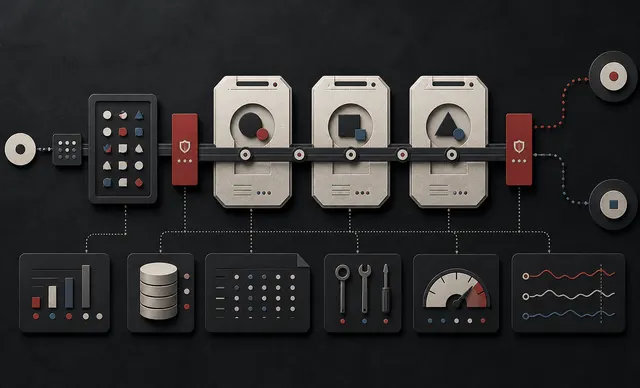
An AI agent can call tools and choose its next step. Orchestration is the application logic that decides how those steps fit into a controlled, observable process.
The distinction matters because adding more agents does not automatically add reliability. It can multiply latency, cost, permissions, and failure paths. A good orchestration design begins with the simplest workflow that can satisfy the task and introduces autonomy only where fixed logic is genuinely insufficient.
Workflow, agent, and orchestration
A workflow follows paths that developers define in advance. It may call a model to classify, extract, summarize, or draft, but application code determines the sequence and allowed transitions.
An agent receives an objective and has some freedom to choose actions. It may select tools, inspect results, revise a plan, and stop when it believes the task is complete.
Orchestration coordinates those components. It manages state, routes work, enforces limits, handles retries, records events, and determines when human approval is required.
Anthropic’s guide to building effective agents makes a useful practical distinction between predefined workflows and systems in which a model dynamically directs its process and tool use. It also argues for simple, composable patterns before elaborate frameworks.
Start with one bounded component
Before designing a multi-agent team, test whether one model call, one model with a small tool set, or a deterministic workflow solves the problem.
Multiple agents are justified when a task has boundaries that benefit from separation: independent context, different permissions, parallel subtasks, or a specialist that can be evaluated with its own rubric. They are not justified merely because the task sounds complicated.
Every additional agent creates another prompt, context, model call, state transition, and set of possible errors. If agents can delegate recursively, the number of calls can grow faster than expected. Establish a measurable baseline with the simpler design before adding coordination.
Choose an explicit pattern
Common orchestration patterns solve different problems.
Router
A router classifies a request and sends it to a specialized handler. This works when categories are reasonably stable and each handler has a distinct tool set or instruction set.
Test routing accuracy separately. Include ambiguous and out-of-scope requests, and define what happens when the router is uncertain. A wrong confident route can be harder to notice than a visible request for clarification.
Sequential workflow
One stage produces an artifact for the next: research, draft, fact-check, edit, for example. Use typed outputs and validation between stages rather than passing an unconstrained conversation transcript.
Sequential workflows are easy to inspect but can propagate an early mistake. Later stages should receive the original evidence they need, not only a previous agent’s summary.
Parallel workers
Independent workers handle separable subtasks and a reducer combines their results. Parallelism can reduce elapsed time, but only when the tasks are truly independent and infrastructure supports concurrent load.
The reducer needs rules for conflicts, missing results, and duplicated work. It should not turn five uncertain answers into one confident answer merely by voting.
Supervisor and specialists
A supervisor selects specialists and integrates their output. This can keep specialist context small, but it also makes the supervisor a critical point of failure. Limit delegation depth and total work, and ensure specialists cannot quietly acquire the supervisor’s permissions.
Handoff
Control moves from one agent configuration to another as state changes. Handoffs are useful in long interactions, but ownership must be explicit. Record which component is active, why the handoff occurred, what state was transferred, and what tools became available.
The LangGraph documentation summarizes multi-agent patterns including subagents, handoffs, routers, skills, and custom graphs. The important design choice is not the framework name; it is the state and authority each transition carries.
Make state a contract
Conversation history is not a sufficient state model for consequential work.
Define a schema for the workflow state: task identifier, user authority, evidence, artifacts, completed steps, pending approvals, error history, budget, and terminal status. Each node should read and write only the fields it needs.
A graph-oriented design can make this explicit through state, nodes, and edges, as described in the LangGraph graph model. The same principle can be implemented without that framework. Explicit state makes replay, migration, and testing possible.
Version the state schema. Long-running tasks may resume after application code changes, so the orchestrator must either migrate old state or reject it safely.
Treat tools as privileged interfaces
Tools connect a probabilistic model to deterministic systems. Their schemas and permissions are part of the security boundary.
Prefer narrow operations with validated parameters over arbitrary code, SQL, or HTTP access. Separate read and write tools. Scope credentials by tenant, environment, and task. Require confirmation for destructive, financial, access-changing, or externally visible actions.
The Model Context Protocol tool specification defines tool names, descriptions, input schemas, and optional output schemas, while also warning that tool annotations are untrusted unless they come from trusted servers. A well-formed schema improves interoperability; it does not prove that the server or the data it returns is safe.
Record every proposed and completed tool call with its validated arguments, authorization decision, result category, duration, and side effects. Do not place secrets in the trace.
Bound the loop
An agent loop needs hard limits that do not depend on the model deciding to stop.
Set maximum model calls, tool calls, elapsed time, retries, tokens, and cost. Limit delegation depth and the number of concurrent workers. Define terminal states such as completed, failed, denied, timed out, and awaiting approval.
Retries need classification. A transient network failure may be retried with backoff. An invalid tool argument should return structured feedback. An authorization denial should not be reframed repeatedly until a model finds wording that passes.
Idempotency matters for writes. Retrying “create invoice” or “send message” must not duplicate the effect. Use operation identifiers and check application state before repeating a side effect.
Preserve evidence across agents
Multi-agent conversation can degrade information. One agent summarizes a source, another summarizes that summary, and the final writer receives a confident claim with no visible provenance.
Carry source identifiers and relevant passages alongside derived statements. Let reviewers trace an output back to original evidence. When context must be compressed, record what was omitted and retain the full artifact outside the prompt.
Avoid using another agent’s prose as if it were an independent source. Agent diversity is not evidence diversity when every component relies on the same unsupported statement.
Observe transitions, not only final answers
A final answer may look acceptable while the process was wasteful or unsafe. Trace the workflow as structured events:
- selected route and confidence;
- state version and transition;
- model and prompt version;
- tool request, decision, and result;
- retry reason and backoff;
- approval request and response;
- latency and cost by stage;
- terminal outcome.
Logs should support replay without exposing confidential prompts or credentials. Use access controls and retention limits appropriate to the data.
Anthropic’s guide to evaluating AI agents emphasizes that multi-turn tool use and state changes make agents harder to evaluate. Scenario-level traces help identify where a failure began instead of assigning one score to the final output.
Evaluate the architecture against failure cases
Test each node and transition deterministically where possible, then run end-to-end scenarios.
Include wrong routes, malformed tool results, timeouts, partial parallel failure, stale state, duplicate events, conflicting specialists, prompt injection in tool output, permission changes, and a worker that never terminates. Verify not only the answer but also which tools ran and which side effects occurred.
Research frameworks such as AutoGen demonstrate flexible conversation among customizable agents, tools, code, and human inputs. That flexibility is useful for experimentation, but production acceptance criteria still belong to the application: authorized actions, bounded resource use, reproducible state transitions, and recoverable failures.
A practical architecture rule
Use deterministic code for constraints you already understand. Use a model where interpretation or open-ended planning adds measurable value. Place authorization, budgets, and irreversible effects outside the model.
Begin with one bounded workflow. Add routers, workers, specialists, or handoffs only when an evaluation shows which limitation they solve. Orchestration is successful when it makes the system easier to control and explain—not when the diagram contains the largest number of agents.