Can AI Replace One of Two Mammogram Readers? A UK Trial Asks
The UK's EDITH trial will invite nearly 700,000 women to test AI in breast screening. How the three groups work and when a second person still looks.
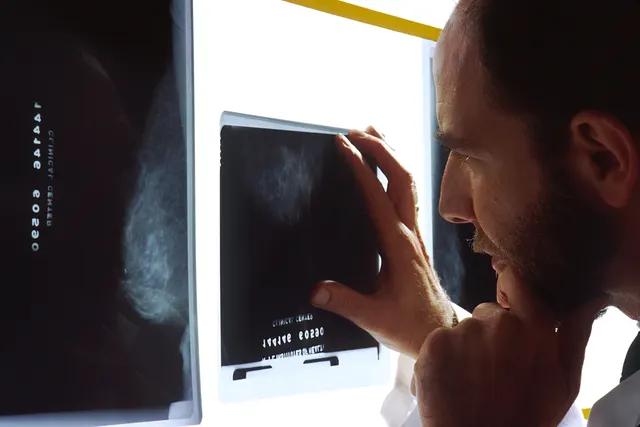
Photo: Bill Branson / National Cancer Institute · Public domain · source

Most mammograms in the UK’s screening program are read by two specialists, and fewer than 1% show signs of cancer. A trial that began recruiting on November 23 will test whether software can safely help with that work, in some cases so that one person reads where two did before. Nearly 700,000 women are due to be invited over the next three years, according to the University of Warwick, which co-leads it with the University of Cambridge.
What started this week
The study is called EDITH, short for Early Detection using Information Technology in Health. Cambridge University Hospitals is the first of 30 planned sites. The £10 million cost is funded through the National Institute for Health and Care Research. By our arithmetic, 700,000 women across 30 sites averages roughly 23,000 per site, though real numbers will vary.
Not every page gives the same target. The participant information page and the Health Research Authority summary both say 660,000, while the launch announcements say nearly 700,000.
Three groups, assigned at random
According to the participant information page, each woman in the study is randomly placed in one of three groups.
| Group | How the mammogram is read |
|---|---|
| 1. Standard | Two NHS experts look for signs of cancer, without AI |
| 2. AI as a safety net | AI looks, after the human reading, for cancers that might have been missed |
| 3. AI as a sorter | AI first rates the likelihood of cancer as high or low; low means one expert checks, high means two |
The third design is where the time saving could come from. If most images have a low rating and need one reader, specialists have more hours for diagnosis and patient care. That is the hope, not a result.
Every image is still seen by at least one human expert, and the organizers say all clinical decisions during the trial stay with NHS staff. When a center first joins, there is also a short setup phase in which two experts read as usual and may consider what the AI reports.
Warwick says four AI systems were tested for accuracy before being used. The announcements we read do not publish those test figures.
What counts as success
Catching more cancers is only one measure. The researchers list the number, size and type of cancers found, how many women are called back for further tests, how each AI system performs for different groups of women, staff workload, costs, and how women and staff feel about it.
They will also count interval cancers, meaning cancers that turn up between screening rounds. These matter because a missed tumor cannot show up in the results on the day of the scan. The Health Research Authority summary says women will be followed for a further four years through the screening program and cancer registries. So answers about missed cases will take time.
The trade-offs
More flags are not automatically better. The information page warns that AI may mark more areas as suspicious than people would, and some will not be cancer. That could mean more recalls, more worry and, for those recalled, a small amount of extra radiation from additional imaging.
The workforce pressure is real but separate. The Royal College of Radiologists, which welcomed the trial, says its own research shows more than a fifth of breast radiologists are due to retire by 2030. It calls the trial promising but not a quick fix.
For women invited at a participating center, the appointment itself does not change. The invitation letter explains the study and how to opt out, in which case two experts read the images without AI. Opting out after the appointment keeps the data out of the results, but cannot undo an AI reading that has already happened. The NHS says it will change routine screening only if the evidence shows the new approach is as safe and effective as current care.
Cambridge University Hospitals posted this short clip about the trial, featuring co-lead Professor Fiona Gilbert and a patient, Shirley, who is not a participant.
The photo above is a 1992 National Cancer Institute image of film mammograms, not a scene from this trial. For a wider look at why a good test score is not the same as good performance on the job, see how to evaluate an AI model beyond benchmark scores.