Why One Twitch Can End an Olympic Sprinter's Race: The False Start Rule Explained
How track and field's one-false-start-and-you're-out rule works, the science behind its 0.1-second threshold, and why it remains genuinely controversial.
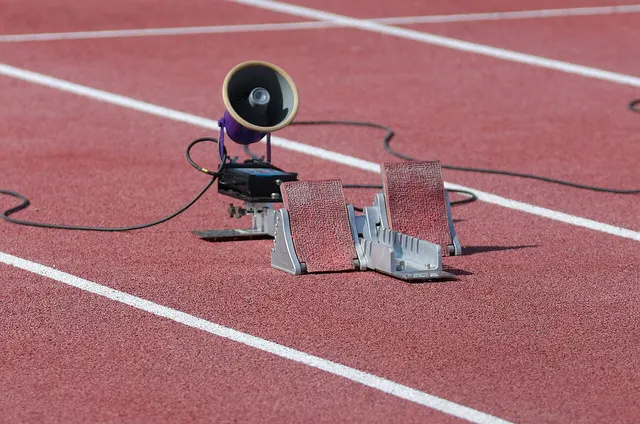
Photo: Clément Bucco-Lechat · CC BY-SA 3.0 · source

A single sprinter can be disqualified from an Olympic or World Championship final before the race has properly begun, on the basis of a movement measured in thousandths of a second. That rule has ended some of the biggest names in the sport’s careers on the sport’s biggest stages, and it remains one of the most debated regulations in athletics.
What counts as a false start
Under World Athletics rules, a false start is any detectable movement out of the blocks before the starting gun fires, or — in modern electronic timing terms — any reaction faster than a fixed threshold after the gun. Starting blocks are wired with pressure sensors that measure the force an athlete applies against them the instant the gun sounds. If that reaction registers before 0.1 seconds have elapsed, the certified Start Information System automatically flags a potential false start, which officials then confirm before applying a disqualification, as described in World Athletics’ technical rules.
Where the one-false-start rule came from
That’s a relatively recent, and still-contested, piece of the system. The rule was not always this strict. From 1 January 2003, according to the then-IAAF’s own announcement of the new false start rule, only one false start per race was allowed without disqualification: the first false start drew a warning for the whole field, and any athlete who false-started after that was disqualified, even if it was that athlete’s first. The summary in Wikipedia’s entry on false starts describes the same one-warning-per-race system. From 2010 the rule was tightened again: except in combined events, any athlete responsible for a false start is disqualified immediately, with no warning, as World Athletics sets out in its comparison of false starts under the two rules, which also counts an average of 28 false starts at the 2007–2009 global championships under the old rule against 10 at the 2011 World Championships under the new one.
The change was driven partly by frustration with athletes deliberately testing the field’s nerves with early movements, and partly by broadcasters and organisers wanting cleaner, more predictable start sequences for television.
The science behind the 0.1-second line
The 100-millisecond cutoff is not an arbitrary round number — but it is also not as scientifically settled as it might appear. It originates from 1990s research testing a small group of Finnish sprinters, whose average reaction times came out around 119–121 milliseconds with meaningful individual variation, according to an analysis of the threshold’s origins. The 100-millisecond line was set below that average specifically to try to separate genuine reactions to the gun from anticipatory jumps.
Physiologically, a reaction to sound involves the signal travelling from the ear to the brainstem, then out to the relevant leg muscles, then the muscles physically contracting against the blocks — a chain that some estimates put at a theoretical minimum around 80–85 milliseconds. That means it is plausible, in principle, for an elite athlete to react legitimately in under 100 milliseconds, even though the rule treats any such reaction as an automatic false start. This is exactly why some sports scientists and athletes argue the threshold may unfairly penalise a small number of genuinely fast reactors, particularly since the original study did not test elite, race-day sprinters or account for possible differences between athletes.
Why disputes keep happening
Because the rule offers no room for a warning or a second attempt, and because the underlying scientific threshold has known limitations, false-start disqualifications at major championships routinely provoke controversy — from arguments about whether the sensor correctly identified the offending athlete, to broader complaints that a career-defining race can end on a measurement most spectators cannot see happen. World Athletics has periodically had to publicly clarify that it has not changed the rule, in response to recurring public pressure to loosen it after high-profile disqualifications.
The takeaway
The false-start rule is deliberately strict by design: zero tolerance, decided by an automated sensor, with no do-overs. It reflects a real trade-off — fewer delays and gamesmanship at the start line, at the cost of occasionally disqualifying an athlete whose reaction may have been a legitimate, if unusually fast, response to the gun.
Athletics is not the only sport where a rule written for fairness ended up defining the event — see also why full-body ‘supersuits’ were banned from competitive swimming.