A Spacecraft Is Flying a Square Orbit Around an Asteroid at 12 cm/s. Why?
ESA's Hera reached the asteroid pair NASA's DART hit in 2022. Why it flies box-shaped paths at a crawl, what its first image shows, and what comes next.
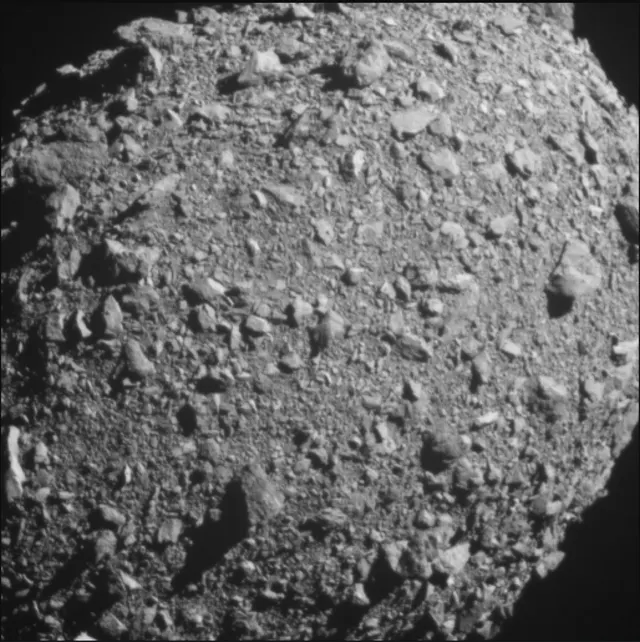
Photo: NASA/Johns Hopkins APL · Public domain · source

A spacecraft that crossed the inner solar system for two years has just arrived at its target, and it is now moving at about 12 centimetres per second. The European Space Agency says that is roughly the speed of a fast-crawling insect. And instead of circling its target the way satellites circle Earth, it flies in straight lines and turns corners, tracing what ESA calls a “rectangular orbit.”
The spacecraft is Hera, the target is the Didymos asteroid pair, and the slow, boxy flight path is the safest way to work near two rocks whose gravity is almost not there. Here is what happened, why the geometry looks so odd, and what the mission is meant to settle.
What just happened
On 11 November 2026, ESA announced that Hera had arrived at the Didymos binary asteroid system and was about 25 to 30 kilometres from it, beginning what the agency calls the “early characterisation phase.” A day later it released a first image preview, taken from 56 km away. It shows one face of Didymos, the main asteroid, which ESA gives as 780 metres across. Part of its moonlet, Dimorphos, 151 metres across, peeks out near the top of the frame, mostly hidden in shadow.
Hera launched on 7 October 2024, according to ESA’s mission page. The image came from the Asteroid Framing Camera. The German Aerospace Center (DLR) says it is the scientific lead for that camera and that Hera carries two identical units for redundancy.
The first picture is a teaser. ESA says detailed images of both asteroids will be released on 25 November.
Why the system matters
Dimorphos is the asteroid NASA hit on purpose. On 26 September 2022, NASA’s 580-kilogram DART spacecraft struck it at 6.1 kilometres per second. ESA says the impact threw a debris plume across 10,000 km and shortened Dimorphos’s orbit around Didymos by about 33 minutes.
That test showed that a spacecraft can nudge an asteroid. It did not show why the nudge was so effective. ESA lists the open questions on its pages: whether the impact left a crater or reshaped Dimorphos, what the moonlet is made of and how its structure and mass are arranged, and which properties explain a deflection much greater than simulations predicted. Hera is there to measure what DART could only change.
There is a wider scientific payoff too. Science News reports that astronomers think binary asteroids make up about 15 percent of all asteroids, so understanding one well helps with many others.
Why a square, and why so slow
Everything about Hera’s path follows from how weak the gravity is. ESA says Didymos pulls about 40,000 times more weakly than Earth does, and Dimorphos about 200,000 times more weakly. At that level a classic circular orbit is impractical. So Hera flies almost in straight lines, circling the pair’s common centre of gravity at about 12 cm/s.
The pattern, as ESA describes it, is three days of approach and then four days moving away. At each turning point the thrusters rotate its course by 90 degrees. Stack those legs together and the track looks like a box, which is why ESA’s caption calls it a “square orbit.”
ESA gives two reasons for flying this way:
- It is safe by design. If a thruster firing fails, the spacecraft simply drifts away from the asteroids instead of heading toward them.
- It is cheap. Low velocities mean each manoeuvre needs only a tiny amount of propellant.
ESA says the approach is derived from experience flying its Rosetta comet mission.
The next step changes the geometry again. Next month, Hera is due to move closer, starting from about 20 km, onto more complex paths ESA calls “bowtie-shaped hyperbolic arcs.” Further on comes the close-up “crash site investigation” of Dimorphos that ESA expects over the coming months.
A ridge that may explain a moon
The first image already contains a puzzle. ESA says it shows large boulders, smoother regions and “a surprisingly sharp equatorial ridge” on Didymos. Didymos rotates about once every 2.2 hours. According to ESA, models suggest that this fast spin may move surface material from higher latitudes toward the equator, and that some material may have been shed from Didymos, possibly explaining how Dimorphos formed.
That is a hypothesis, not a result. The mission exists to test it, and a single image from 56 km away cannot do that. The detailed images due on 25 November are the first chance to see more of the surface.
What comes after the survey
Hera will not do all the work alone. ESA says it will deploy a pair of shoebox-sized CubeSats for a still closer survey of Dimorphos. Science News reports that the two small companion spacecraft are to be released in January. One of them, Juventas, carries a radar meant to look inside Dimorphos. Planetary scientist Angela Stickle of the Johns Hopkins Applied Physics Laboratory says “We’ve never seen the interior of an asteroid before,” in the Science News account. ESA says a landing is planned eventually.
A mission flown from 196.5 million km away
Hera is run from ESA’s ESOC operations centre in Darmstadt, Germany. The spacecraft is in contact for about eight hours a day, across a distance of 196.5 million km, through four 35-metre deep-space antennas in Argentina, Spain and Australia. ESA says its Flight Dynamics team uses telemetry to work out where the spacecraft is and to compute the commands for each planned move.
Those long-distance observations are one more case of agencies pointing instruments at a target from far away and trusting the physics. We saw the same cross-checking logic in the 2026 ozone hole story, where satellites, balloons and forecasts are cross-checked to understand one large system.
What to take from it
First, Hera’s slow box-shaped orbit is not a quirk. It is the sensible answer to gravity roughly 40,000 to 200,000 times weaker than Earth’s. Second, the DART impact is only half of a planetary-defence experiment. The other half is measuring what it did, and that is Hera’s job. Third, almost everything beyond the first image is still pending: the detailed pictures on 25 November, the closer arcs next month, and the CubeSats in January.
What the sources do not yet say is how much material the impact moved, whether there is a crater, or why the deflection beat the simulations. Those answers depend on the measurements that Hera is only now beginning to take.