How to Resist AI-Enabled Fraud Without Becoming a Deepfake Expert
A verification and transaction-control playbook for cloned voices, synthetic identities, impersonation, phishing, and payment fraud.
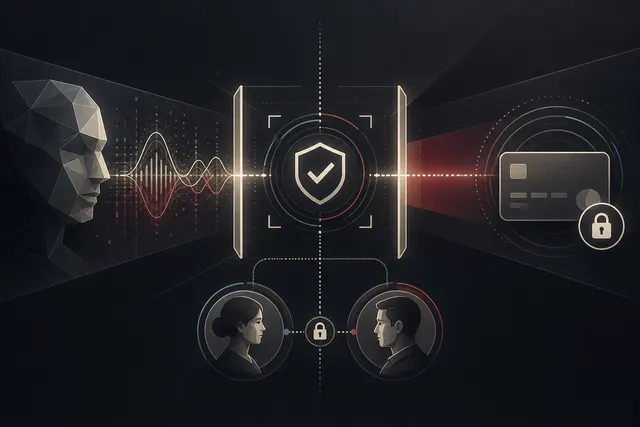
AI can make a fraudulent message more polished, translate it, imitate a familiar voice, generate a plausible face, or produce convincing documents. It does not remove the attacker’s need to make a victim disclose something, authorize a transaction, install software, or bypass a control.
That is the defensive opportunity. People do not need to recognize every synthetic artifact. They need processes that remain safe when an email, call, video meeting, identification image, or executive instruction looks and sounds real.
The FBI’s Internet Crime Complaint Center has warned that generative AI can increase the scale and believability of financial fraud, including impersonation, synthetic documents, voice cloning, and video. The right response is not blanket distrust. It is independent verification tied to the risk of the requested action.
Verify the request, not the performance
Visual glitches, unnatural pauses, strange wording, and inconsistent lighting can justify caution. None is a reliable authentication method. High-quality synthetic content may have no obvious defect, while compression or a poor connection can make authentic media look suspicious.
Instead, identify what the sender wants:
- money transferred or payment details changed;
- credentials, one-time codes, recovery keys, or personal data;
- remote access or software installation;
- confidential files or an exception to policy;
- secrecy, urgency, or movement to another channel;
- an identity decision based on a document, selfie, or video call.
The higher the consequence, the stronger and more independent the confirmation should be. Authentic media does not prove that a request is authorized. A real executive can have a compromised account, and a genuine invoice can contain an attacker’s substituted bank details.
Use a trusted path back
Do not verify a suspicious request by replying to the same message, calling a number it supplies, or clicking its link. Those routes remain under the claimant’s control.
Use a channel established before the incident:
- call a saved number or one from an authoritative directory;
- open the bank, vendor, or government site from a bookmark or typed address;
- ask another known person to contact the alleged sender;
- verify a payment change with an existing vendor contact;
- require an in-person or cryptographically authenticated step for exceptional risk.
The FBI’s guidance on AI-enabled impersonation follows this principle: do not trust a familiar voice or appearance alone; contact the person through a number already known to belong to them. A family code word can help, but it should supplement rather than replace a trusted callback because code words can also leak.
Put friction around irreversible actions
Fraud succeeds when one persuasive interaction can trigger an irreversible result. Design workflows so that no single message can do that.
For organizations:
- require two authorized people for new beneficiaries and high-value payments;
- separate creation of a payment from approval and release;
- place a cooling-off period on bank-detail changes;
- confirm changes using the vendor contact already on record;
- show approvers exactly what changed, not merely that a request exists;
- restrict emergency overrides and review every use;
- alert the original account owner through a separate channel;
- log the evidence, approver, destination, and reason.
For individuals, pause before sending gift-card numbers, cryptocurrency, wire transfers, or account-recovery codes. Urgency and secrecy are signals to switch channels, not reasons to skip verification.
Strengthen account authentication
AI-generated messages can make phishing more credible, but account compromise still depends on credentials or sessions. Require multifactor authentication and prefer methods that cryptographically bind authentication to the legitimate service.
CISA recommends phishing-resistant MFA. The current NIST Digital Identity Guidelines explain assurance levels and authentication controls. NIST’s technical guidance identifies WebAuthn/FIDO2 as an example of verifier-name-bound phishing resistance.
This matters because a one-time code typed into a fake site can be relayed. A correctly implemented passkey or security key is designed to authenticate to the intended domain. Also protect enrollment, device replacement, help-desk reset, and account recovery; attackers often choose the weakest lifecycle step.
Do not let video become identity proof
A live face or familiar voice is evidence, not a complete identity protocol. For remote onboarding or sensitive recovery, combine independent signals and expect attackers to replay, synthesize, or recruit another person to pass a check.
A risk-based process may include:
- validation of identity evidence against authoritative sources;
- device, account-age, and transaction-history signals;
- liveness and media-forensic checks as supporting controls;
- a verified return channel;
- manual review with clear escalation criteria;
- limits until confidence increases over time.
Do not collect extra biometric data merely because it is available. More sensitive data creates more breach and privacy risk. Document what each check proves, where it fails, and how a legitimate user can recover from a false rejection.
Prepare a verification script
People under pressure follow familiar procedures better than improvised warnings. A short script can be:
- Stop. Do not disclose, approve, install, or transfer anything yet.
- Record the sender, channel, exact request, destination, and deadline.
- Contact the person or organization through a known route.
- Confirm both identity and the precise action, including changed payment details.
- Escalate exceptions to a second authorized person.
- Preserve messages, headers, numbers, recordings, URLs, and transaction identifiers.
- If anything was disclosed, contain the account or payment immediately and report through the relevant official channel.
Training should rehearse realistic executive, supplier, help-desk, recruitment, romance, family-emergency, and government-impersonation scenarios. Measure whether the process catches the request, not whether participants correctly label a file as AI-generated.
If someone has already acted
Speed matters. Contact the financial institution through its official channel and ask whether a transfer can be stopped or recalled. Lock or reset affected accounts from a trusted device, revoke sessions and tokens, rotate exposed credentials, and preserve evidence before messages disappear.
Notify the impersonated person or organization, internal security or fraud staff, and the appropriate reporting service. In the United States, the FBI directs internet-fraud reports to IC3, while consumer scams can be reported to the FTC. Other jurisdictions have their own police, cybercrime, banking, and identity-theft channels.
Avoid “recovery” services that promise to retrieve lost funds for an advance fee. Previous victims are valuable targets because an attacker already knows the loss, contact details, and desire for help.
The durable control set
AI changes the quality and volume of deception more quickly than it changes the foundations of fraud prevention. A resilient system has:
- trusted callback routes;
- transaction separation and dual approval;
- phishing-resistant authentication;
- protected recovery and help-desk procedures;
- explicit rules for urgent exceptions;
- evidence preservation and rapid response;
- regular tests using current attack styles.
The goal is not to prove that every voice or image is genuine. It is to make a convincing imitation insufficient to cause harm.