How to Verify Synthetic Media Without Trusting a Single Detector
A layered workflow using original files, provenance credentials, source context, reverse search, forensic analysis, and explicit uncertainty.
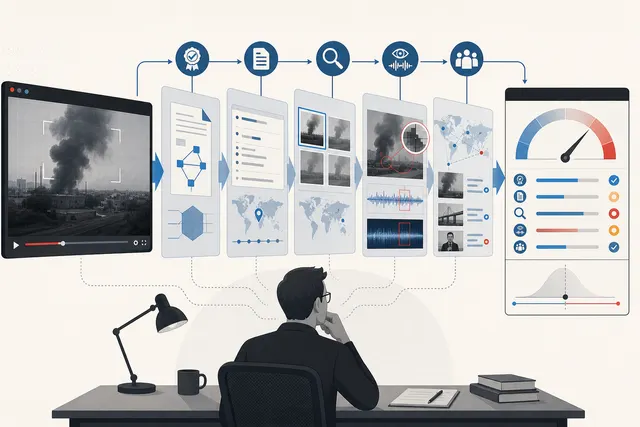
A detector score cannot establish that an image, recording, or video is real. Detectors make errors, models change, files are recompressed, and an authentic recording can still be presented with a false date or caption.
Verification is a process of building and challenging a provenance claim. It combines the original file, its source and publication history, cryptographic credentials when available, independent corroboration, and media forensics. The result may be confirmed, contradicted, or unresolved.
That last category is important. “Unverified” does not mean “AI-generated,” and “no AI detected” does not mean “true.”
Define the claim before examining pixels
Media can mislead in several ways:
- entirely synthetic content depicts an event that never occurred;
- authentic footage is edited to change meaning;
- a real image is paired with the wrong place, date, or identity;
- audio is cut or reordered;
- a reenactment or satire is presented as documentary evidence;
- an authentic file comes from an impersonated account;
- a generated element is inserted into otherwise real material.
Write the exact claim that needs verification. “Is this video fake?” is too broad. Better questions are: Was this file captured by the claimed device? Was it published before the alleged event? Does it show the stated location? Was the audio modified? Is the speaker the claimed person?
Different claims require different evidence.
Preserve the best available file
Download or request the original file before platforms resize, transcode, strip metadata, or detach credentials. Record:
- the URL, account, post identifier, and retrieval time;
- the visible caption and surrounding thread;
- file size, format, dimensions, duration, and cryptographic hash;
- whether the platform served a derivative rather than the upload;
- every transformation performed during analysis.
Work on a copy. A hash proves that the evidence has not changed since collection; it does not prove that the content was authentic at collection time.
Screenshots are poor evidence when the original post or file exists. They remove timing, audio, metadata, resolution, and provenance information. Preserve the screenshot only as a record of how a claim appeared.
Trace the source and chronology
Find the earliest known publication, not merely the most viral repost. Search distinctive frames, phrases, landmarks, and audio. Compare timestamps carefully across time zones and platform displays.
Ask:
- Is the account the original creator or an aggregator?
- Does the account have a history consistent with the claimed access?
- Can the creator provide adjacent frames, raw footage, or another angle?
- Did the same file appear before the event it supposedly documents?
- Do weather, shadows, public schedules, maps, and contemporary reports fit?
- Are independent witnesses relying on the same upload or separate evidence?
Ten articles embedding one viral clip are not ten independent sources.
Context verification often resolves a case without determining whether pixels were generated. An old photograph with a new caption is misinformation even when every pixel is authentic.
Check Content Credentials correctly
The C2PA standard defines a way to attach cryptographically verifiable provenance statements to media. A Content Credential can describe creation, edits, ingredients, tools, and other assertions. Hashes bind the manifest to an asset, and digital signatures identify the signer associated with the claim.
The current C2PA technical specification is explicit about the boundary: validation establishes that assertions are associated with the asset, correctly formed, and tamper-evident under a trust model. It does not decide whether the depicted event is true or whether a signer is honest.
When a credential is present:
- Validate the asset binding and manifest signature with a current implementation.
- Inspect the signer and certificate trust status.
- Review creation and edit assertions, ingredients, timestamps, and redactions.
- Look for gaps between manifests or transformations outside credential-aware tools.
- Decide whether the signer and asserted workflow support the specific claim.
The C2PA explainer notes that provenance may be incomplete and cannot by itself determine factual truth. A signed camera capture can document origin while the scene itself is staged. A signed synthetic image can transparently document that it was generated.
Absence of credentials proves little
Content Credentials are opt-in and not universally preserved. Platforms, editors, messaging apps, screenshots, and format conversions may remove embedded metadata. Older or independent capture devices may never add it.
Therefore:
- valid credentials can provide positive evidence about origin and history;
- invalid credentials can indicate tampering, corruption, implementation error, or a mismatched file;
- missing credentials do not establish that content is fake;
- credentials claiming AI use do not automatically establish malicious deception.
Durable approaches can use fingerprints or watermarks to recover external manifests after some transformations, but those mechanisms have their own false-match, removal, and availability risks.
Treat watermarks as one signal
A watermark may be visible or imperceptibly embedded. It can indicate that a participating generator created content or help recover provenance.
Watermarks can be degraded by cropping, compression, noise, re-recording, or deliberate removal. A robust watermark may still fail on a heavily transformed derivative. An absent watermark may mean the generator never added one.
False positives are especially consequential when the conclusion accuses a real person of fabrication. Watermark detection needs a documented threshold, error rates under expected transformations, and confirmation that the detector and generator versions are compatible.
NIST’s report on reducing risks from synthetic content treats provenance tracking, watermarking, labeling, and synthetic-content detection as related but distinct technical approaches. No single mechanism covers every content source and threat.
Use synthetic-content detectors cautiously
A detector estimates whether features resemble examples in its training and evaluation data. It may perform well on a curated benchmark and poorly on a new generator, camera pipeline, language, demographic group, or platform compression setting.
Before relying on a score, ask:
- Which content types and generators were evaluated?
- Were test generators excluded from training data?
- What are false-positive and false-negative rates at the chosen threshold?
- How does recompression, resizing, denoising, cropping, or re-recording affect results?
- Is performance reported per file, frame, segment, or person?
- Does the detector expose calibrated probabilities or an opaque percentage?
- Has it been independently evaluated on material similar to this case?
Run more than one method only if their errors are meaningfully independent. Three products built on similar training data do not create three independent confirmations.
Never convert “78% AI” into a claim that 78% of the file was generated or that there is a 78% probability of deception unless the system’s documentation supports exactly that interpretation.
Examine physical and temporal consistency
Forensic review can identify inconsistencies, but visual oddities are not a checklist proof of AI generation. Real cameras create blur, rolling shutter, noise, compression artifacts, stabilization errors, and unusual lighting.
Useful analyses include:
- frame-by-frame continuity and duplicated regions;
- audio waveform, spectral continuity, and room acoustics;
- synchronization between speech, lips, reflections, and environmental sound;
- lighting direction, shadows, perspective, and geometry;
- sensor noise and compression history;
- metadata consistency and editing traces;
- comparison with known locations, objects, voices, or camera behavior.
NIST’s Open Media Forensics Challenge reflects the broader forensic problem: detecting manipulated media and tracing digital-content origins across deepfakes, generative content, computer graphics, and anti-forensic techniques.
Specialist conclusions should describe the method and uncertainty. “This frame looks strange” is an observation, not a forensic determination.
Verify audio as both signal and event
Voice cloning can imitate timbre while errors in wording, context, room acoustics, or turn-taking reveal problems. But telephone compression and noisy recordings can also confuse detectors.
Seek the original recording, not a video of a speaker playing from another phone. Compare with verified speech recorded in similar conditions. Check whether the alleged speaker, venue, participants, and timeline can be independently corroborated.
For urgent financial or safety instructions, do not attempt to authenticate the voice within the same call. End the interaction and use a separately obtained contact method plus a prearranged verification process.
Build an evidence table
For consequential material, record each item rather than relying on an overall impression:
| Evidence | Supports | Contradicts | Limitation |
|---|---|---|---|
| Original file and hash | Chain of custody | — | Starts at collection, not capture |
| Source chronology | Claimed date or creator | Earlier conflicting publication | Platforms alter timestamps |
| Valid Content Credential | Signed provenance assertions | Unexplained workflow gap | Does not prove scene truth |
| Independent footage | Event occurred from another view | Material scene differences | May share the same upstream source |
| Forensic analysis | Specific manipulation signature | Camera-consistent pipeline | Method error and unknown generators |
| Detector result | Similarity to evaluated synthetic media | Strong real-media classification | Domain shift and threshold uncertainty |
This structure makes missing evidence visible and prevents one dramatic score from dominating the conclusion.
Use conclusion categories that match the evidence
A practical scale is:
- Verified provenance: origin and relevant history are supported by validated credentials and corroboration.
- Corroborated authentic event: independent evidence supports the event, though the full file history may be incomplete.
- Manipulated: analysis identifies a material edit; specify which part and how confidently.
- Synthetic: strong evidence shows content generation; do not imply malicious intent without separate evidence.
- Miscontextualized: content may be authentic but the date, place, identity, or caption is false.
- Unverified: available evidence cannot resolve the claim.
Publish what would change the conclusion. A later original file, signer confirmation, platform record, or independent angle may strengthen or reverse it.
A rapid verification sequence
When time is limited:
- Preserve the post and best available file.
- State the exact factual claim.
- Locate the earliest known source and prior versions.
- Check validated provenance credentials and metadata.
- Seek independent event corroboration.
- Inspect key frames, audio, and context for specific inconsistencies.
- Use detectors only with documented scope and error rates.
- Record alternative explanations and confidence.
- Escalate high-impact cases to a qualified forensic analyst.
- Label unresolved material as unresolved.
The strongest question is not “Can a detector spot AI?” It is “What trustworthy evidence connects this file to this source, history, and real-world claim?” Provenance technology can strengthen that connection. Context and forensics can challenge it. None should be asked to carry the entire conclusion alone.