How Undersea Internet Cables Get Repaired — and Why Outages Last Weeks
An explainer on how cable ships locate breaks in submarine internet cables, repair them at sea, and why the process routinely takes one to five weeks.
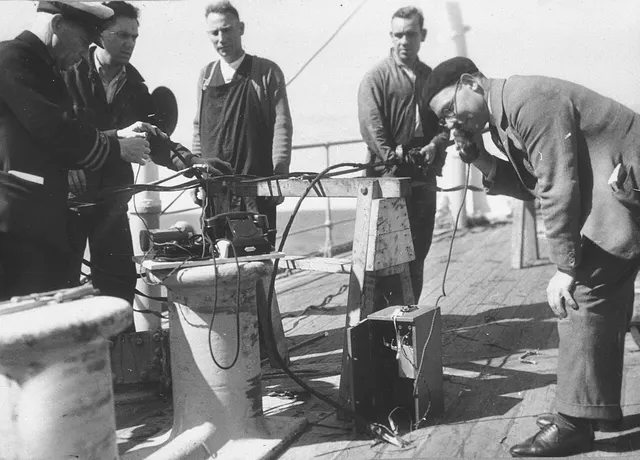
Photo: State Library of New South Wales collection · No restrictions · source

More than 95% of intercontinental internet and data traffic travels through cables laid on the ocean floor, yet these cables get damaged far more often than most people realize. Industry data cited by TeleGeography puts the number at roughly 200 faults a year worldwide. Most are fixed without the public ever noticing, but when a fault does cause a visible outage, repairs can take anywhere from about a week to over a month. Here’s what actually happens between the cut and the fix.
What breaks the cables in the first place
The overwhelming majority of faults aren’t dramatic. TeleGeography’s data attributes roughly two-thirds of all cable damage to ordinary human activity — commercial fishing gear dragging along the seabed, and ships accidentally dropping anchor across a cable route, especially in shallow coastal waters where routes are more concentrated. Earthquakes and underwater landslides account for a smaller share of faults, and equipment failures inside the cable’s own components — the repeaters that boost the optical signal every so many kilometers — happen occasionally. Deliberate sabotage and animal bites, despite getting outsized media attention, are comparatively rare causes.
Finding the exact break point
Repair crews don’t need to search blindly along a cable that can stretch thousands of kilometers. The operator responsible for maintaining the cable first estimates the fault position from tests carried out at the terminal stations at either end, according to KIS-ORCA’s guide to submarine cable maintenance. Once the repair ship reaches that area, crews narrow the location down with one of three techniques: electroding, in which the terminal station sends a low current along the cable and the ship trails two electrodes over the suspected area until the signal drops away; a remotely operated vehicle (ROV) that follows a tone placed on the cable, where the depth allows, and looks for physical damage; or side-scan sonar that images the seabed for scars and other signs that the cable has been hit.
What a repair ship actually does
Once the location is known, a specialized cable ship sails to the site carrying spare cable — commonly enough to splice in a replacement section — along with the tools to test and rejoin fiber strands. These ships use dynamic positioning systems, holding a precise location using thrusters rather than an anchor, which matters because dropping their own anchor near a repair site would risk causing exactly the kind of damage they’re there to fix.
Where depth allows, an ROV can attach a gripper to the cable so it can be lifted; otherwise the ship drags a grapnel — a device with multiple hooks on a long rope — along the seabed to cut or hook the cable. The first recovered end is sealed and buoyed off while the second is brought aboard, cleaned and stripped back to its individual fibres, which are spliced to a new section of cable before the joint is sealed and moulded. The ship then lays the new section back to the buoy, recovers the first end and makes a second joint the same way before the repaired cable is lowered to the seabed, as KIS-ORCA describes the process.
Why the whole process takes weeks, not days
The jointing work on board is often the smallest part of the timeline. Repair ships are shared, limited resources serving huge stretches of ocean, so there’s frequently a queue before a ship is even available to respond to a new fault. Sailing to a remote fault location can itself take days. Weather is a major variable — cable-laying and repair work generally can’t proceed safely in high seas, so a storm can push a repair back by a week or more with no advance warning. On top of that, ships need to be loaded with the correct type and length of spare cable in advance, and larger modern repair vessels capable of carrying thousands of kilometers of cable can themselves take weeks just to load before departing. In places with multiple redundant cable routes, an outage may barely register for users because traffic simply reroutes; in regions served by only one or two cables, the same fault can mean a national-level slowdown that lasts for the entire repair window.
Why this rarely makes the evening news
Because faults are frequent and mostly routine, and because major internet infrastructure is typically built with redundant paths, the vast majority of the roughly 200 annual faults cause no visible disruption at all. It’s only when a fault affects an under-served region, or when several faults happen close together, that the repair timeline becomes a public story rather than routine maintenance.
Takeaway: Cable breaks are routine — roughly 200 a year, or close to four a week on average — and are handled by a small global fleet of specialized ships. The repair work itself is a comparatively short part of the job once a ship arrives, but locating the fault, reaching it, and weather all stack up to make outages last, on average, one to several weeks.
When enough of this capacity goes down at once, the outage becomes measurable at national scale — see how internet blackouts are measured and how researchers detect them.