Nearly 2,100 Wild Species Were Found Indoors in the US and Canada. Who's Sharing Your Home?
A new Ecology paper maps 23,782 photographed sightings of wild creatures inside homes. What the survey counted, how it works, and what it can't tell you.

Somewhere in your home right now, a spider you never noticed may be eating something you never noticed either. A study published this week in the journal Ecology puts numbers on that hidden household: nearly 2,100 wild species recorded indoors across the United States and Canada, from lady beetles to house centipedes. Here is what the researchers counted, how they did it, and why the figures need careful reading.
Everything below comes from a North Carolina State University news release dated Nov. 20 and the public dataset record on Zenodo, which describes the same data. Both come from the research team’s side, so the claims are the authors’ own. We did not have access to the full paper, which the release lists as “The biodiversity of human dwellings: A dataset of 24,000 observations of indoor life in the United States and Canada,” published Nov. 19.
What the survey found
The team, led by Bradley Allf, now at Colorado State University, with NC State professor Rob Dunn as senior author, assembled 23,782 observations. They span every U.S. state and Canadian province, though no territories, according to the dataset record. The sightings were made between May 1996 and April 2024, with most from 2018 on.
The headline numbers, as reported by NC State and Zenodo:
- Nearly 2,100 species appear in the data.
- About 60% of observations are insects and about 30% spiders. NC State puts arthropods, the group that also includes centipedes and crustaceans, at about 95% overall.
- About 4% are chordates, mostly reptiles and mammals.
- Eight species were each seen more than 200 times: the Asian lady beetle, brown marmorated stink bug, house centipede, varied carpet beetle, long-bodied cellar spider, triangulate combfoot spider, bathroom moth fly and Eastern parson spider.
The release also says many of the commonest animals are predators, including hundreds of spider species, and that some help control household pests. The researchers call the dataset the largest of its kind to date. That label is theirs; we did not compare it with other surveys.
How the counting works
Nobody walked through thousands of houses with a clipboard. The data come from Never Home Alone, a citizen-science project on the iNaturalist platform that began in 2018, according to Zenodo. Volunteers, about 3,000 of them, photographed “wild organisms” in homes, offices, schools and other buildings. Pets and potted plants were excluded.
Each record carries a location, a date and an identification of the organism, plus information about the observer and the expert who reviewed it. NC State says dozens of entomologists, arachnologists and other specialists checked the identifications. That review step matters: it turns a pile of phone photos into data a scientist can cite.
Why “nearly 2,100” is not the final count
The species total is probably too low, and the release explains why. About 44% of the observations could not be identified down to species, so they cannot add to the species count even though a species is certainly there. A photo of a blurry spider may be a genus at best.
Rarity is also built in. NC State says about 52% of the species were observed indoors only once, and Zenodo gives roughly 1,100 single-record species, which is consistent. Some of those are likely to be visitors that wandered in, not residents.
What the survey cannot tell you
This is a count of what people noticed and photographed, not a measured census of what lives in homes. The authors say data collection was not controlled for effort, so biases are likely. One they name is that large-bodied animals are probably overrepresented: a beetle on a window sill gets a photo, a mite in the carpet does not.
They also note that some of the organisms were probably trapped indoors, not living there by choice. A stray visitor and a long-term resident would each appear as a single record.
Even the “most common species” ranking is a ranking of what people photograph. A distinctive insect that is easy to spot can climb the list while a tiny, common one stays out of it. The same sampling problem haunts any count that relies on who shows up to be counted, a theme we covered in our explainer on census undercounts.
Why researchers want it anyway
Messy as it is, the dataset gives scientists something they lacked: a continental baseline. The team says it plans to look at how species are distributed, how outdoor climate shapes what turns up inside, which species arrived by accident and which seem adapted to buildings. A baseline from 2018-2024 can later show whether a species is spreading or retreating.
The project is ongoing, so the numbers will keep changing. The NC State release says people can still submit observations. The dataset is openly licensed under CC BY 4.0, so other researchers can check the work and run their own analyses.
What to take from it
First, a home is a small ecosystem, and the animals in the study are overwhelmingly small arthropods that most residents never meet. Second, the study documents presence, not harm: the sources we read do not say the species found are dangerous or that anyone should do anything about them. Third, the figures are lower bounds from volunteers’ cameras, not a full inventory.
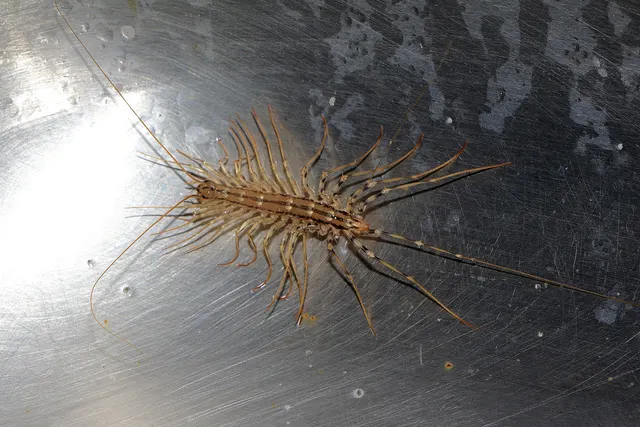
The photo above shows a house centipede, one of the eight species seen more than 200 times in the survey. It is a general photograph of the species from Wikimedia Commons, not an image from the study.