Matrix Multiplication's Speed Limit Is n^2.25, OpenAI Claims
OpenAI's Nov. 24 preprint says the matrix multiplication exponent is exactly 9/4. What that means, how Strassen's trick works, and what is still unchecked.
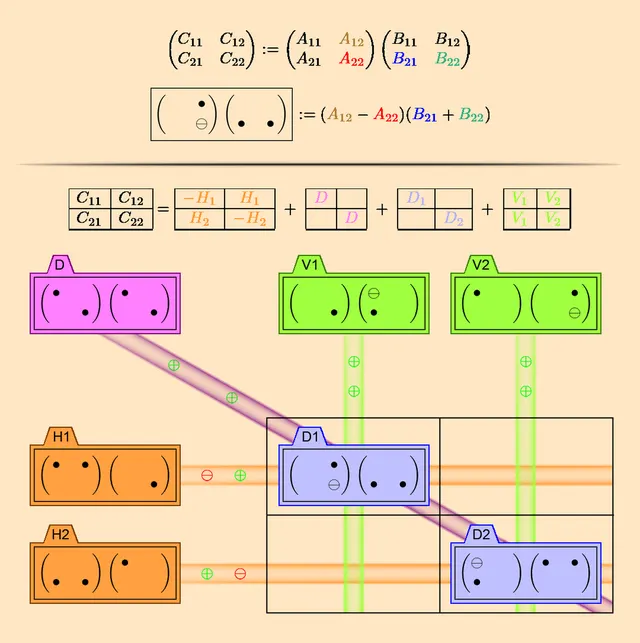
Photo: Fractalone · CC BY-SA 4.0 · source

Multiplying two 1,024-by-1,024 grids of numbers the school way takes more than a billion multiplications. How much can clever bookkeeping cut that? On Nov. 24, OpenAI posted a preprint claiming a final answer: the cost of multiplying big matrices grows like n^2.25, the exponent is exactly 9/4, and nothing can go meaningfully below it. If the proof holds, it rules out a famous hope: that the exponent is 2. We found no independent check of the new half of the proof yet.
Everything about the claim comes from OpenAI’s preprint and the README of the repository that hosts it. Both are OpenAI’s own statements. For the older half of the story we used two arXiv papers by authors who are not named on the OpenAI preprint.
What a matrix exponent is
Multiplying two n-by-n matrices (square grids of numbers) means filling n x n answer cells, and each cell is a sum of n products. The school method therefore uses about n^3 multiplications. In 1,024 x 1,024 terms, that is 1,073,741,824.
The preprint opens by noting that Strassen’s seven-product identity showed work could be shared between cells. Strassen’s trick, in the hero diagram above, multiplies two 2 x 2 matrices with seven multiplications instead of eight. Applied repeatedly to blocks, that saves a power of n: the cost drops to about n^2.81 (our arithmetic: log base 2 of 7). The exponent, called omega, is the smallest power of n that works. Since the answer has n^2 cells, omega can’t be below 2, and a long-standing conjecture asks whether it equals 2.
What OpenAI claims
The preprint’s abstract says the exponent of square matrix multiplication is 9/4 over every field, and that “the upper bound was known.” The new part is the lower bound: for each n of at least 2, a formal arithmetic circuit for two n x n matrices needs at least n^(9/4)/2 multiplication or division gates, even if additions are free. The paper credits the upper bound to OpenAI over the complex numbers, and to Amanov, van den Berg and Zuiddam over every field.
Put together, 9/4 is both reachable and a floor, so omega is not 2. For 1,024 x 1,024 matrices, the paper’s formula implies any exact bilinear method needs at least about 5.9 million products. That figure is our arithmetic, not a number in the paper.
| Method, 1,024 x 1,024 | Multiplications |
|---|---|
| School method (n^3) | 1,073,741,824 |
| Strassen applied all the way down (7^10) | 282,475,249 |
| Floor from the preprint’s formula (n^(9/4)) | about 5.9 million |
| Size of the answer (n^2) | 1,048,576 |
The preprint describes its argument in one sentence: a smaller exponent would compress “tensor networks” enough to violate a lower bound for testing whether the entries in each of several lists are all distinct. We cannot independently judge that proof.
What other mathematicians have written
Two arXiv papers rework the upper bound only, not the new part. Rafael Pass’s paper, submitted Oct. 20, gives what it calls a constructive and elementary proof of omega at most 9/4, and says OpenAI first established the bound over the complex numbers. A Nov. 6 paper by Doğan, Lysikov, Sakabe and Walter is an exposition of OpenAI’s upper bound with a different tool. Neither says anything about the Nov. 24 lower bound, which appeared after both. We found no independent check of it.
How the work was produced, and what is unverified
The repository README says its manuscripts and proof artifacts come from an unnamed internal OpenAI model, with exceptions it lists. It calls the papers “raw research data” rather than polished academic work, says the collection holds results at different stages of verification, and says some unformalized results could have issues. It also reports that about 42% of top-line results have Lean formalizations, machine-checked proofs.
For this family of results, a Lean scope note on the same repository describes its model as division-free programs, while the preprint’s theorem also counts division gates. We did not check how much of the lower-bound proof the Lean files cover. The preprint is not peer reviewed.
What it does not mean
The result is about counting operations as n grows without limit, in a formal model where the matrix entries are independent variables. It does not say a faster program exists for real hardware, and none of the sources we read claims one. AI chips spend much of their time on matrix multiplication, as in OpenAI’s own chip-design post, but their speed depends on memory and hardware layout as well as the operation count.
What to take from it
First, the claim is concrete and testable: a clear exponent and a clear lower-bound formula. Second, the half that was already known has been reworked in papers by other authors; for the new half we found no such check. Third, the source is the claimant, so treat “exactly 9/4” as a strong claim awaiting review.