The Ozone Hole Got Bigger This Year. Why It's Still Healing
The 2026 Antarctic ozone hole is the biggest in a decade by area, yet far shallower than past records. How the polar vortex and chlorine explain it.

Headlines this autumn said the Antarctic ozone hole was back in a big way. Both halves of that are true, and they point in opposite directions. NASA and the National Oceanic and Atmospheric Administration (NOAA) reported this month that the 2026 hole ranked seventh largest by area in 48 years of monitoring, and, in the words of NASA’s Paul Newman, grew to proportions “we haven’t seen in a decade.” In the same report, they said the ozone layer remains on track for long-term recovery.
The two statements fit together once you know what “size” measures, what a polar vortex does, and why the chemistry behind the hole is slowly being switched off.
What actually happened in 2026
According to NASA, the hole reached its greatest one-day extent on September 18, at about 10.5 million square miles (27.1 million square kilometers). Averaged over September 7 to October 13, the peak depletion season, it covered about 9.6 million square miles (25 million square kilometers). Scientists define the “hole” as the region where total ozone falls below 220 Dobson units, a historical threshold, and the Dobson unit is the standard measure of how much ozone sits in a column of air.
Europe’s Copernicus Atmosphere Monitoring Service (CAMS) saw the same shape from a different angle. The hole passed 15 million square kilometers, more than the area of Antarctica, by the end of August, then grew sharply in early September to an estimated 25 million square kilometers on September 12, roughly 5 million above the average for that date. The German Aerospace Center (DLR), reading data from the TROPOMI instrument on the European Space Agency’s Sentinel-5P satellite, reported an area of up to 27 million square kilometers as of September 20.
Three agencies, one consistent picture: a large hole. Yet each of them also flagged the catch.
Big is not the same as deep
Area counts how much of the map falls under the 220-unit line. It says nothing about how thin the ozone gets inside. On depth, 2026 was unremarkable. NOAA balloon measurements at the South Pole found the lowest reading overhead was 105 Dobson units on October 17. The lowest ever recorded over the pole was 92 units in October 2006. CAMS likewise found that the lowest column value within the hole and the total “ozone mass deficit” stayed close to average, and DLR said ozone levels inside the hole had not fallen to exceptionally low values.
Think of a puddle. A wide, shallow puddle can cover more pavement than a narrow, deep one without holding more water. A hole with a large footprint but modest depth is a different event from the severe, deep holes of earlier decades.
The trend also points the right way. NASA’s Paul Newman noted that the hole has been forming later in the season in recent years, “which tells us the ozone layer is healing.” DLR pointed out that 2025’s hole was unusually small. NASA added that, had ozone-depleting substances been as abundant today as at their peak in 2000, this year’s hole could have been 1 to 2 million square miles larger.
Why a stronger polar vortex stretched it
If the chemicals are declining, why the extra size? The answer is weather in the stratosphere. The polar vortex is a ring of fast winds circling Antarctica in winter and spring. It acts like a container: air inside is isolated, stays extremely cold, and is cut off from warmer, ozone-rich air from lower latitudes.
NOAA’s Amy Butler explained that the vortex was unusually large this year in part because planetary-scale weather systems, which normally travel upward from the lower atmosphere and help break up the vortex, were especially weak in August and September. With weak wave action, the strongest winds stayed several degrees of latitude farther from the pole, leaving a bigger region with ideal conditions for ozone loss. CAMS tied the rapid early-September growth to a sudden drop in minimum temperature about 20 kilometers above the South Pole.
This is natural year-to-year variability layered on top of a slowly improving baseline. DLR makes the same point: factors such as vortex size and Antarctic temperatures vary considerably from year to year.
The chemistry the vortex switches on
Ozone is made of three oxygen atoms. It forms when solar ultraviolet radiation splits ordinary oxygen molecules, and the ozone layer sits in the stratosphere, roughly 7 to 31 miles (11 to 50 kilometers) up, where it absorbs much of the sun’s harmful UV. NASA stresses this is separate from ground-level ozone, which is a pollutant.
The damage comes from human-made chemicals. Chlorofluorocarbons (CFCs) and halons were widely used as refrigerants, aerosol propellants and in fire extinguishers. They are stable near the ground, drift up into the stratosphere, and are eventually broken apart by UV, releasing chlorine and bromine atoms. These atoms act as catalysts: they destroy ozone without being used up, so a single atom can wreck a very large number of ozone molecules before it is removed.
Antarctica adds two conditions. First, the extreme cold inside the vortex lets polar stratospheric clouds form, thin ice-crystal clouds that provide surfaces where chlorine and bromine compounds are converted into forms that attack ozone. Copernicus notes that global warming, which tends to cool the stratosphere, can favor these clouds. Second, the process needs sunlight to run the reactions. That is why the hole opens as sunlight returns in late winter and the austral spring, and why, per DLR, it usually ends in early December, once the vortex breaks down and warmer air mixes in.
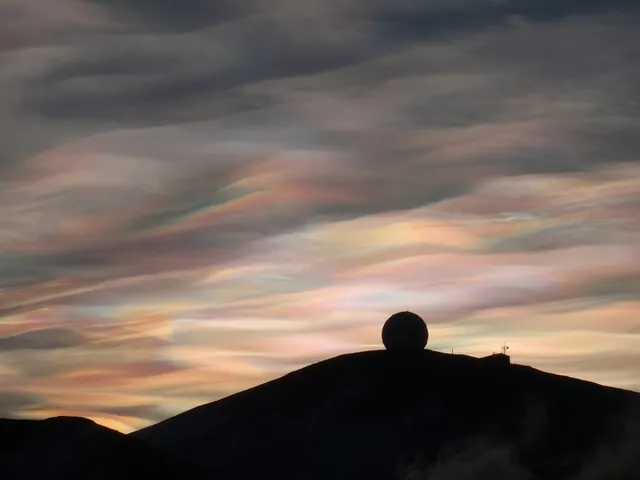
The clouds themselves can be seen with the naked eye. Nacreous, or mother-of-pearl, clouds of the kind photographed above glow at sunrise and sunset in cold polar skies, a visible sign of the very conditions that make ozone loss possible.
Why recovery is still on track
The reason the long-term story is good is a treaty. The Montreal Protocol, signed in 1987 and in force since 1989, phases out the production and consumption of ozone-depleting substances. According to the United Nations Ozone Secretariat, it has been adjusted or amended six times, most recently with the 2016 Kigali Amendment that phases down hydrofluorocarbons (HFCs). Those chemicals replaced ozone-depleting ones, and while they do not harm the ozone layer, they are powerful greenhouse gases.
NASA says the Protocol stopped the growth of these substances in the atmosphere. If that progress continues, it adds, the Antarctic ozone hole could be restored to 1980 levels by about 2070. That timeline explains why scientists tolerate a “big hole” year without declaring the treaty a failure: the chemicals still in the air decay slowly, so recovery is measured in decades, and weather can push any single season up or down.
What to watch next
Because the hole is defined by a threshold, an unusual season shows up first in the area figure, while depth and total ozone loss tell you how serious it really is. When you see a headline about a record or near-record hole, three checks help: is it area or depth, is the vortex unusually strong or cold, and where does the multi-year trend sit?
Monitoring is built to answer exactly these questions. Satellites on NASA, NOAA and ESA missions, balloons launched from the South Pole station, and forecasting from services like CAMS cross-check one another, much as the world’s timekeepers cross-check clocks, a process described in our explainer on why leap seconds are being retired.
The hole is expected to close again by early December. The question for the coming decades is not whether any single year is big, but whether the later onset, smaller depth and declining chlorine keep stacking up. So far, the data says they do.