

Strategy (MSTR) Is Now Wall Street’s Most-Shorted Stock
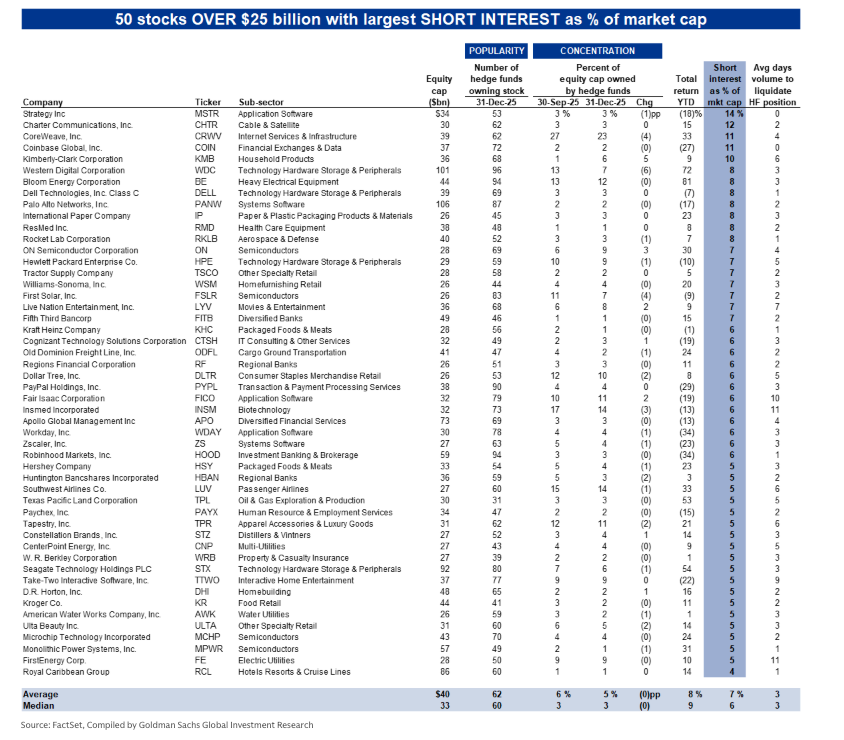
Strategy (MSTR) has moved to the very top of Wall Street’s crowded-short leaderboard, according to a Goldman Sachs screen of the 50 stocks above $25 billion with the largest short interest as a percentage of market cap, a positioning shift that matters for the market because MSTR has effectively become a listed, levered proxy for Bitcoin exposure.
Wall Street Crowds Into Shorts On Strategy
In Goldman’s table, Strategy ranks No. 1 with short interest equal to 14% of market cap, ahead of Charter Communications at 12%. CoreWeave and Coinbase follow at 11% each, with Kimberly-Clark next at 10%. After that, the list compresses quickly: Western Digital, Bloom Energy, Dell, Palo Alto Networks, and International Paper all sit at 8%.
Related Reading
The screen adds context on size and hedge-fund footprint. Strategy shows an equity cap of roughly $34 billion, with 53 hedge funds owning the stock as of 31-Dec-2025. Hedge funds owned about 3% of Strategy’s equity cap at both 30-Sep-2025 and 31-Dec-2025, and the table shows a (18)% total return year-to-date for the period captured, alongside 0 average days of volume to liquidate the hedge-fund position.
By comparison, Charter sits around $30 billion in equity value with 62 hedge funds owning it, also at roughly 3% hedge-fund ownership on both dates, and a 15% YTD return, with 2 days to liquidate.
CoreWeave shows a different profile: about $39 billion in equity cap, 62 hedge funds owning it, and high hedge-fund ownership—27% at 30-Sep-2025 dropping to 23% by 31-Dec-2025—with 33% YTD return and 4 days to liquidate.
Coinbase appears at roughly $37 billion equity cap with 72 hedge funds owning it, about 2% hedge-fund ownership on both dates, a (27)% YTD return, and 0 days to liquidate.
That dynamic is exactly what Fundstrat’s Tom Lee pointed to in a post on X, framing heavy shorting as a positioning signal rather than a fundamental verdict. “More signs of a meaningful low in place,” Lee wrote. “When a stock becomes a ‘consensus’ short, it is also a crowded trade… Hence, a stock can rise on ‘bad news’ because the bad news is priced in.”
Related Reading
Brian Brookshire, advisor to Moirai Capital and former Head of Bitcoin Strategy at Swedish firm H100, added: “I suspect a lot of this short interest is still MSTR / BTC basis trade. Jane Street, in particular, has recently acquired a conspicuously large IBIT position. All bets are off when, not if, the BTC bull market returns. mNAV expansion during BTC’s ascent is a spectacular thing.”
Saylor’s Message To Bears: “Short us”
Strategy executive chairman Michael Saylor has been unusually direct about what the company is and what it is not, trying to be for the market. In a prior interview, he argued that heavy short interest is a natural consequence of a company choosing to be a pure expression of a Bitcoin-heavy balance sheet.
“You know, my real aspiration now is, if you really hate Bitcoin, I want you to love us,” Saylor said. “Like, we’re the perfect instrument to short, right? Because I promise you I won’t sell it, right? We’re going to be levered long Bitcoin. And if you don’t like it, or if you just want to hedge it, you get to sell our stock or sell puts or buy puts, right?”
Saylor’s point wasn’t simply that shorts are welcome, it was that Strategy’s posture is designed to be legible. “We have been laser-like focused. We’re very consistent. We’re very transparent,” he said, before reiterating the operating promise: “We’re going to buy Bitcoin, never sell Bitcoin. We’re going to borrow money intelligently.”
For Bitcoin-native investors, the practical takeaway is that MSTR’s equity has become a high-conviction battleground for BTC exposure: longs treat it as an amplified bet on BTC and capital markets access, while shorts treat it as the cleanest way to fade that package.
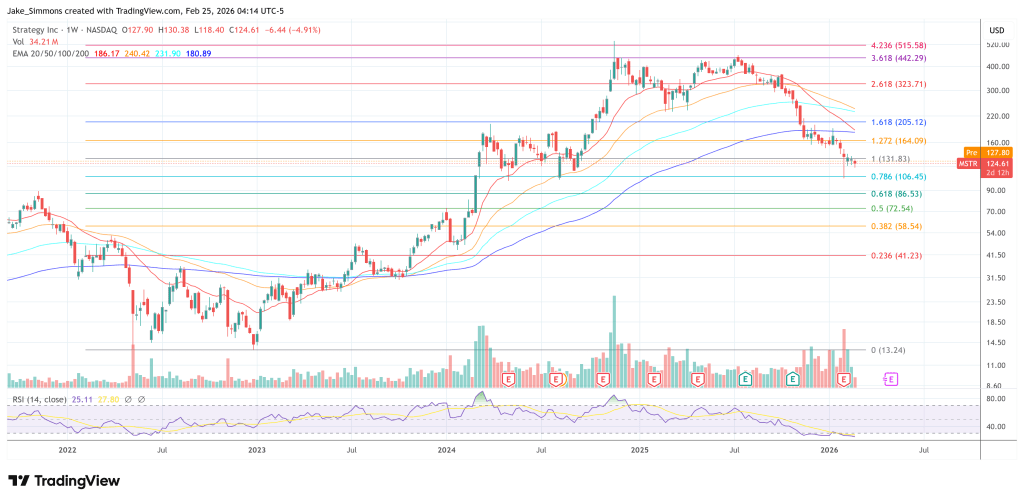
At press time, MSTR traded at $127.80.
Featured image created with DALL.E, chart from TradingView.com


