Voyager 1 Hit One Light-Day. Why Has Its Data Stopped?
Voyager 1 became the first craft one light-day from Earth on Nov. 18, but NASA has had no science data since Nov. 14. What is known so far.
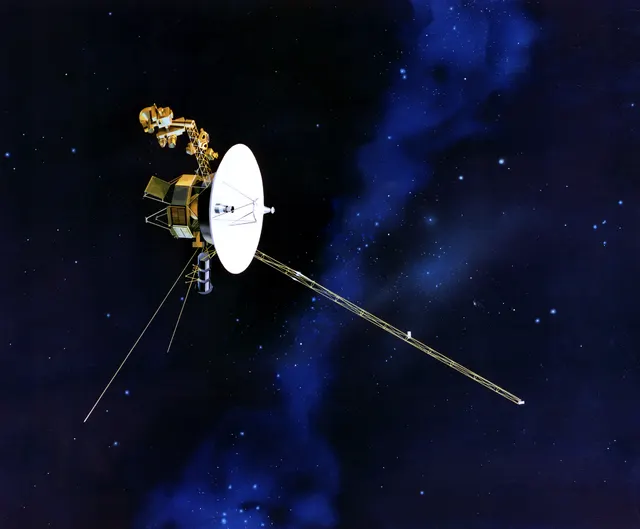
Photo: NASA/JPL · Public domain · source

At 2:16 a.m. Pacific time on Nov. 18, Voyager 1 became the first human-made object to be one light-day from Earth. Four days earlier, it had stopped sending back science and engineering data. Both things are true at once, and the gap between them is the story.
NASA’s news release describes the milestone as the end of more than 49 years of travel. It also says the team has not received science or engineering data from the spacecraft since Nov. 14. This article explains what a light-day is, how NASA can claim a milestone from a probe that is not sending data, and what engineers are doing about it.
What a light-day is
A light-day is the distance light travels in 24 hours. NASA gives it as 16,094,799,096 miles, or 25,902,068,356 km, on its light-day explainer page. The release rounds that to about 16.1 billion miles (25.9 billion km).
The release offers a ladder of travel times for sunlight: about 1.3 seconds to reach the Moon, about four hours to reach Neptune, and roughly 20 more hours to reach Voyager 1. Add those up and you get the day in the unit’s name.
A quick check of our own, not a NASA claim: the release lists a light-year as about 5.88 trillion miles. Divide that by 365 days and you get roughly 16.1 billion miles, which matches the light-day figure.
The practical consequence is the delay. Project manager Suzanne Dodd says signals now take 24 hours to reach the spacecraft and 24 hours to come back. A question sent today gets its answer in about two days at the earliest.
What went wrong on Nov. 14
According to a NASA blog post from Nov. 18, the team learned on Nov. 14 that Voyager 1 had stopped sending science and engineering data. A Deep Space Network antenna in Canberra, Australia, locked on to the spacecraft and received a carrier signal, but no data came with it.
A carrier signal is the bare radio wave that data normally rides on. NASA says it is informative anyway. It shows that the Attitude and Articulation Control computer is still keeping the spacecraft pointed at Earth, and that the antenna and broadcast equipment still work. The missing data, NASA says, points to the onboard computer that gathers readings from the subsystems and science instruments and formats them for transmission.
Two other facts from the blog shape the picture:
- A 2023 precedent. Voyager 1 had a similar carrier-without-data episode in 2023, caused by one of its onboard computers. NASA says the spacecraft resumed sending engineering updates in April 2024, and that the team’s experience then is guiding the current effort.
- An October gap. In October, contact was lost for about 48 hours. The spacecraft resumed communication on its own and operated normally until Nov. 14. The team is checking whether the two events are connected.
An independent report by The Register tells the same story from NASA’s updates. We treat it as a secondary source and use NASA’s own wording for every claim above.
How the milestone stands without data
If the probe is silent, how can NASA say where it is? The blog’s answer is that distance does not depend on the data. The figure comes from trajectory models built on years of measurements. Voyager 1 moves away from Earth at a steady speed, about 38,000 mph per the release, on a known path, and it cannot change that speed. The team used the carrier signal and trajectory calculations to confirm the milestone, so the engineering fault cannot affect when it is reached.
In plain terms: the carrier proves the spacecraft was still there, and arithmetic does the rest.
Why a fix could take weeks
Diagnosis is slow because every step takes two days to complete. NASA says working out the cause may take weeks or longer, and that engineers are still working on it. It has not named a cause for the current outage. The blog says only that the symptoms point at the data-handling computer.
The age of the hardware does not help. The release says the spacecraft’s radioisotope thermal generator is about 50 years old and that both Voyagers lose about 4 watts of power per year. Earlier in 2026, engineers turned off three devices and swapped in lower-power alternatives, a step the release says carries risk. The aim is to keep the current science instruments running until at least the probes’ 50th launch anniversaries next summer.
What it means
Voyager 1 entered interstellar space in 2012, according to NASA. Voyager 2 crossed that boundary in 2018 and, per NASA’s light-day page, is expected to reach one light-day in November 2035. For now, Voyager 1 is the only object this far out.
The release quotes Dodd: “We listen to Voyager 1 every day and send commands to the spacecraft weekly.” The blog adds a sober note: the mission expects to eventually lose both Voyagers to engineering problems that cannot be fixed, and plans to keep them running and returning science for as long as possible.
What to take from it
First, the record and the outage are separate. One is geometry, the other is a computer 16 billion miles away. Second, a carrier signal without data is a sign of life, not of full health. Third, the open question is whether the 2023 fix can be repeated. NASA has not said how long recovery will take, and as of its Nov. 18 post, it had not named a cause.
For another recent story about a spacecraft working far from home, see our explainer on the Hera probe’s square orbit.