What Sodium-Ion Batteries Can—and Cannot—Replace
A practical comparison of sodium-ion and lithium-ion batteries across chemistry, energy density, temperature, cycle life, safety, cost, supply chains, and lifecycle impact.
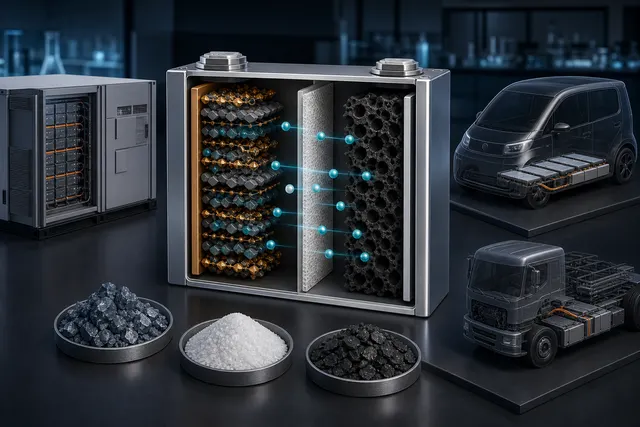
Sodium-ion batteries are not “lithium-ion batteries with a cheaper element swapped in.” They use a related rocking-chair principle—ions move between host materials during charge and discharge—but sodium’s size, mass, electrochemical potential, and compatible electrode structures change cell voltage, energy density, durability, temperature behavior, manufacturing, and economics.
That makes sodium-ion a credible option for some stationary storage, starter batteries, compact vehicles, and mixed-chemistry packs. It does not make the chemistry an automatic replacement for every lithium-ion cell in long-range vehicles, phones, aircraft, or space-constrained equipment.
Compare products, not elements
“Sodium is abundant” is true at the resource level but insufficient for a battery decision. A commercial cell also requires processed cathode material, hard carbon or another anode, electrolyte salts and solvents, separator, current collectors, binders, casing, formation, controls, pack hardware, manufacturing yield, logistics, and recycling.
Sodium-ion itself is a family. Cathodes can include layered oxides, polyanionic compounds, or Prussian-blue analogues. Anodes are commonly hard carbon. Electrolyte and additives vary. Those choices affect voltage, capacity, cycle life, safety, cost, moisture sensitivity, and material supply.
Do not confuse room-temperature sodium-ion cells with high-temperature sodium-sulfur or sodium-metal-halide systems. They have different electrolytes, operating conditions, hazards, and applications.
Why energy density is usually lower
Lithium is lighter and has a more negative standard reduction potential than sodium. Sodium ions are larger, which constrains host materials and transport. In practical cells, sodium-ion chemistries have generally delivered lower gravimetric and volumetric energy density than leading lithium-ion chemistries.
Lower cell energy density propagates through the pack. More cells, casing, busbars, cooling, structure, and space may be required for the same usable energy. That can reduce vehicle range or payload and increase installation footprint. Pack design, state-of-charge window, degradation reserve, thermal system, and safety spacing determine whether a headline cell value survives at system level.
Manufacturer claims are evidence of a stated product target, not independent fleet data. CATL’s 2025 Naxtra announcement, for example, reported 175 Wh/kg for a passenger-vehicle sodium-ion cell and described low-temperature, cycle-life, and safety performance. A buyer would still need validated production-cell specifications, pack-level values, duty-cycle tests, warranties, manufacturing scale, and field evidence.
Energy density matters most where mass and volume are expensive: long-range vehicles, aviation, portable electronics, robotics, and constrained machinery. It matters less for a grid cabinet with available land, a short-range urban vehicle, or a starter battery selected primarily for power and temperature performance.
Low temperature is not one number
Some sodium-ion formulations can retain useful capacity and power at low temperature, which is attractive for cold-climate vehicles, starter systems, and outdoor storage. But “works at minus 40” can refer to different tests: discharge power, usable energy, pulse output, charging, or survival after exposure.
Ask for curves rather than one endpoint:
- charge and discharge power across temperature and state of charge;
- usable energy at specified rates;
- permitted charging current when cold;
- preheating energy and time;
- resistance growth and cycle degradation after repeated cold operation;
- pack temperature gradients and sensor tolerances;
- behavior after long storage at low and high temperatures.
A battery that can discharge in extreme cold may still require controlled heating before fast charging. Compare the complete thermal-management system and energy consumed by conditioning.
Safety depends on cell and system design
Sodium-ion materials may offer thermal-stability advantages in some formulations, and certain transport states can simplify logistics. That does not make every sodium-ion battery non-flammable or immune to internal short circuits, overcharge, manufacturing defects, mechanical damage, propagation, toxic gases, or control failure.
Require evidence at cell, module, pack, and installed-system levels. Test overcharge, external short, crush or penetration as appropriate, vibration, thermal exposure, cooling failure, propagation, water ingress, isolation, sensor faults, charger faults, and emergency response. Review electrolyte, vent products, enclosure, spacing, detection, suppression, and post-incident handling.
“Safer chemistry” should be translated into measured probability and consequence under the intended failure modes. It is not permission to remove monitoring, containment, certification, or operating limits.
Cycle life is duty-cycle specific
Cycle-life claims depend on depth of discharge, charge and discharge rate, temperature, state-of-charge window, rest periods, endpoint capacity, and cell pressure. A shallow grid-balancing cycle is not equivalent to a full vehicle cycle. Calendar ageing can dominate applications that cycle infrequently.
Layered-oxide cathodes illustrate why chemistry labels are too broad. A 2024 Energy & Environmental Science review describes cycle-life limitations from phase transitions, Jahn–Teller effects, and interface deterioration, along with material and surface strategies to mitigate them.
Procurement tests should reproduce the expected profile:
- energy throughput and depth-of-discharge distribution;
- calendar time at temperature and state of charge;
- power pulses and regenerative charging;
- cold starts, fast charging, and thermal conditioning;
- storage, standby, and partial-state-of-charge operation;
- end-of-life power, efficiency, and safety requirements.
Compare warranted energy throughput and retained power, not only a cycle count.
Cost will not follow raw sodium alone
Sodium feedstocks can be inexpensive and geographically broad. Some sodium-ion designs avoid lithium, nickel, cobalt, or copper at the anode current collector. Those are meaningful supply and cost opportunities. Early products can still cost more per delivered kilowatt-hour because production volumes, yields, hard-carbon supply, equipment utilization, qualification, financing, and pack integration are immature.
Lithium-ion benefits from massive installed capacity, learning, standardized components, established suppliers, and intense competition. Its price also changes with mineral markets. Sodium-ion’s commercial advantage may therefore be resilience and optionality as much as an immediately lower cell price.
The IEA’s Global EV Outlook 2026 battery analysis notes that sodium-ion manufacturing capacity remains a small fraction of lithium-ion capacity and that hard-carbon production is less developed and concentrated. The IEA’s supply-chain mapping also shows that abundant sodium does not automatically produce a diversified industrial chain.
Calculate system cost from usable lifetime energy and required service:
- delivered cells and pack integration;
- installation, land, structure, and grid connection;
- thermal management and auxiliary energy;
- efficiency losses;
- augmentation and replacement;
- monitoring, maintenance, warranty, and insurance;
- recycling, transport, and end-of-life handling;
- downtime and performance risk.
Manufacturing is similar enough to help—and different enough to hurt
Sodium-ion developers can reuse parts of lithium-ion manufacturing knowledge and equipment, including coating, calendaring, assembly, electrolyte filling, formation, and pack integration. Reuse can accelerate scaling, but materials behave differently. Moisture control, hard-carbon consistency, electrode loading, gas generation, electrolyte wetting, formation protocol, quality inspection, and yield require chemistry-specific validation.
The US Department of Energy’s technology strategy assessment for sodium batteries identifies research and deployment needs spanning electrodes, electrolytes, interfaces, manufacturing scale, demonstrations, standards, validation, supply chains, lifecycle assessment, and end of life. Laboratory performance is only one step toward bankable systems.
For a supplier, request production-line yield, statistical cell distributions, traceability, formation time, quality escapes, change-control policy, and evidence that pilot values persist at commercial scale.
Environmental performance is conditional
Avoided lithium, cobalt, nickel, or copper can reduce particular resource and impact categories, depending on chemistry. Sodium-ion cells still consume energy and materials, and lower energy density can require more material per installed or delivered kilowatt-hour. Cathode composition, hard-carbon precursor, electrolyte, manufacturing electricity, lifetime, efficiency, pack design, transport, and recycling all matter.
A prospective 2024 lifecycle assessment found that results depend strongly on future cell performance and production scenarios. That is the correct lesson: sodium-ion is not inherently low-carbon by name. Compare equivalent functions under transparent assumptions.
Check the lifecycle study’s:
- functional unit—cell mass, installed capacity, usable lifetime energy, or delivered service;
- chemistry and bill of materials;
- production geography and electricity mix;
- energy density, efficiency, calendar life, and cycle life;
- pack overhead and replacement rate;
- allocation for co-products and recycled content;
- transport, second life, collection, and recycling assumptions;
- uncertainty and sensitivity ranges.
Recycling processes and markets are optimized around existing lithium-ion volumes. Sodium-ion may use lower-value materials, which can weaken the economic incentive for collection even when recovery is environmentally useful. Product design, regulation, producer responsibility, and contracted take-back may be needed before a mature recycling market exists.
Where sodium-ion fits first
The strongest early applications are those where sodium-ion’s particular combination of power, temperature behavior, material optionality, and acceptable energy density creates system value.
Stationary storage: Space and mass can be less restrictive, but efficiency, lifetime, safety, installed cost, serviceability, and bankability remain decisive. Sodium-ion may fit short-duration or high-cycle services; it does not automatically become long-duration storage merely because it is stationary.
Starter and auxiliary batteries: High power, cold operation, deep-discharge tolerance, and removal of lead can matter more than maximum energy density. Vehicle qualification and long calendar life are essential.
Compact and short-range mobility: Urban cars, two- and three-wheelers, delivery vehicles, and mixed-chemistry packs can accept lower energy density when cost, cold performance, power, or supply diversification compensate.
Long-range passenger vehicles: Sodium-ion can serve some designs or a secondary energy zone, but pack mass and volume make high-energy lithium-ion chemistries difficult to displace broadly.
Portable electronics and aviation: These applications pay heavily for mass and volume, so current sodium-ion designs face a steep disadvantage unless another requirement dominates.
How to evaluate a real product
Run a technology-neutral tender based on duty cycle and site constraints. Require:
- cell and pack gravimetric and volumetric energy density;
- usable state-of-charge window and end-of-life capacity and power;
- efficiency over representative rates and temperatures;
- calendar and cycle degradation under the intended profile;
- cold and hot charge/discharge limits plus thermal-system energy;
- cell, module, pack, and installation safety evidence;
- manufacturing location, capacity, yield, material traceability, and change control;
- warranty terms tied to measured service rather than marketing cycles;
- controls, diagnostics, spare parts, repair, and data access;
- collection, transport, recycling, and supplier-exit plans;
- independent validation of manufacturer claims;
- a lifecycle assessment using comparable functional units.
Pilot enough units to observe distribution, not one ideal sample. Include seasonal conditions, real chargers and inverters, communications failures, sensor faults, maintenance, and recovery after shutdown. Record auxiliary energy and availability as well as cell performance.
A complement before a universal substitute
Sodium-ion batteries can diversify material demand and expand design choices. Their best deployments will come from matching a cell and pack to a particular service, not from assuming sodium always means cheaper, safer, cleaner, or locally supplied.
For stationary storage, cold-weather power, starter systems, compact mobility, and hybrid packs, the trade can already be plausible. Where every kilogram and litre must carry maximum energy, mature lithium-ion chemistries retain a strong advantage. The useful question is not whether sodium-ion will replace lithium-ion. It is which constraints each chemistry solves at the lowest verified system cost and impact over its actual lifetime.