A 16-Pound Frozen Turkey Needs Days to Thaw. Why So Long?
Melting ice soaks up heat and thawed meat slows it down. Why a frozen turkey takes days, the three safe ways to thaw it and the 165°F check.
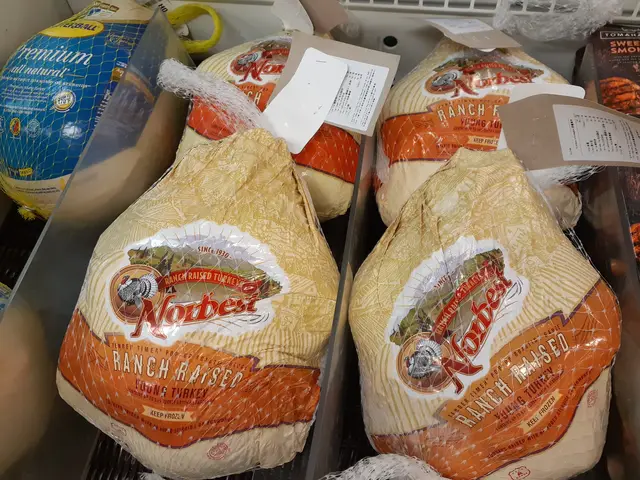
Photo: Goraemhcak slA · CC BY-SA 4.0 · source

A 16-pound frozen turkey needs roughly three to four days in the refrigerator before it is thawed. That is our arithmetic from the USDA rule of thumb that University of Illinois Extension repeats: about 24 hours for every 4 to 5 pounds. The wait comes from physics, and the obvious shortcut, leaving the bird on the counter, is the one food safety agencies tell you to skip.
Melting ice swallows heat
Warming something frozen and melting it are two different jobs. A Food and Agriculture Organization table on ice puts the latent heat of fresh-water ice, the energy needed just to turn it into water, at 80 kilocalories per kilogram. Its specific heat at freezing point is 0.49. By our arithmetic, melting a kilogram of ice takes as much heat as would warm that ice by about 160 degrees Celsius, if it could stay solid.
Meat is mostly a story about the water inside it. We found no equivalent table for turkey among the pages we read, so here is lean fish, from an FAO table of fish freezing data. Warming it from -20°C to 0°C takes about 67 kilocalories per kilogram. About 49 of those, nearly three quarters, are needed in the last stretch, from -4°C to 0°C, where most of the ice melts (both figures are our subtraction from the table). A thermometer stuck in the bird can sit just below freezing for a long time while that work gets done.
The thawed layer gets in the way
Heat reaches the middle of a turkey from the outside, and the outside thaws first. That matters because thawed flesh carries heat less well than frozen flesh. The same FAO fish table gives a thermal conductivity of 0.37 to 0.5 for unfrozen white fish at 0°C and 1.12 to 1.49 for frozen white fish at -1°C, in its own units. Frozen is roughly three times better. So as the soft shell grows, every further bit of heat has to cross a thicker, poorer conductor to reach the ice.
Size adds to it. FAO notes, about freezing times, that doubling a thickness of 100 millimeters or more may increase the time fourfold. That statement is about freezing fish, not thawing turkey, but it shows why thick objects are slow in both directions of the temperature scale.
A refrigerator makes the process gentle on purpose. The FDA says it should stay consistently at 40°F (about 4°C) or below, so the temperature difference driving heat into the bird is small.
Why not the counter
Clemson University’s extension service cites the USDA “danger zone” of 40°F to 140°F, in which bacteria can grow rapidly, and says certain bacteria can double in as little as 20 minutes there. If that fastest rate held for four hours, one cell would become 4,096 (our arithmetic, a worst case rather than a prediction). Freezing does not kill microbes, the same page says; it only slows them.
On a counter, the surface warms into that range while the center is still ice. Illinois Extension warns that bacteria on the outside can multiply to dangerous levels and produce toxins that cooking may not destroy. The FDA’s line is short: never thaw food at room temperature.
The three safe ways
| Method | Time for 16 pounds | Catch |
|---|---|---|
| Refrigerator | about 3 to 4 days | Plan ahead; set the bird on a tray, low in the fridge |
| Cold water | about 8 hours | Keep it wrapped, change water every 30 minutes, cook right away |
| Microwave | see the oven’s manual | The bird must fit; cook right away |
The times are our arithmetic from the rules on the Illinois page, which allows 30 minutes per pound in cold water. Why is water so much quicker? Contact at the surface counts. FAO’s page on freezing times notes that, thanks to better surface heat transfer, a product will normally freeze faster in an immersion freezer than in an air-blast freezer at the same temperature. Our inference is that a water bath helps thawing for a similar reason. Use cold water, not warm or hot. In a microwave, Illinois cautions, defrosting is irregular and can create hot spots.
The U.S. Department of Agriculture’s food safety channel walks through the same three methods in this 2015 video.
Check 165°F, even with a pop-up
Thawed is not the same as cooked. The FDA says a food thermometer is the only way to ensure poultry is safe, and the minimum internal temperature is 165°F (about 74°C). Illinois Extension’s thermometer guide says to check the innermost part of the thigh and wing and the thickest part of the breast.
The pop-up stick that comes in some birds (one label in the photo above advertises it) is simple. An American Institute of Physics brief describes the original design, patented in 1961: a rod, a spring, and a pin of heat-sensitive material, metal or wax, that holds the spring down. The material is chosen to melt at the target temperature, freeing the spring. Designs have changed, but the principle has not. The brief also notes Consumer Reports has warned that some timers can pop before 165°F, and Illinois advises checking with a thermometer anyway. A single stick reads a single spot.
Food safety problems that begin before your kitchen are handled differently; see how food recalls are triggered and traced.