Why Leap Seconds Are Ending — and How the World's Official Time Is Kept
An explainer on how UTC is kept in step with Earth's rotation, why leap seconds were added since 1972, and why metrology bodies chose to stop adding them.
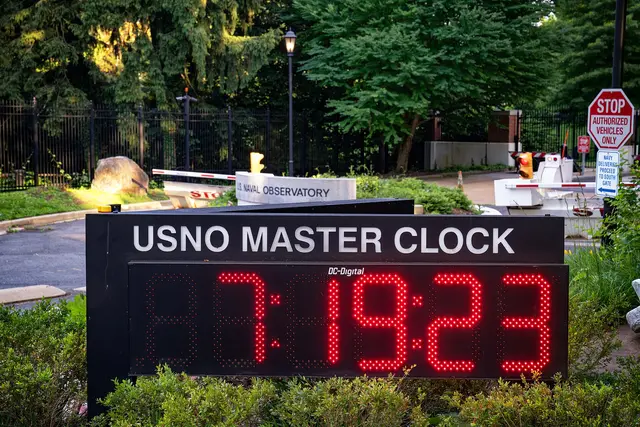

Every clock, server and phone that shows the “correct” time ultimately traces back to Coordinated Universal Time, or UTC. For decades, the people who maintain UTC have occasionally added a single extra second to it so that it stays close to the position of the Earth. That practice is now being retired. The reasons say a lot about how official time is built, and why a one-second correction became a headache for modern infrastructure.
Two clocks that do not agree
UTC is a compromise between two different ways of measuring time. According to the US National Institute of Standards and Technology, UTC is built on International Atomic Time (TAI), which counts seconds from atomic clocks, and is then adjusted with leap seconds to account for the difference between the definition of the second and the rotation of the Earth. The astronomical time scale, UT1, follows the planet itself, and NIST notes that it “changes slightly due to variations in the rotation of the Earth.”
Because those two scales drift apart, the rule was to keep UTC within plus or minus 0.9 seconds of UT1. When the gap approached that limit, one second was inserted into UTC, which is what NIST calls a leap second. The effect is that UTC and TAI separate by exactly one more second each time.
How many there have been
The first leap second was inserted on June 30, 1972. The table maintained by the International Earth Rotation and Reference Systems Service, published through its Earth Orientation Centre at the Paris Observatory, lists 27 steps, each increasing the difference between TAI and UTC by one second. The table starts in 1972 with an offset of 10 seconds, and the 27 leap seconds bring it to 37 seconds, the current difference NIST also reports.
The pattern was irregular. Leap seconds came in most years in the 1970s and early 1980s, then there was a gap of several years between 1999 and 2006 in the table, and the most recent one took effect on January 1, 2017, after being inserted at the end of December 31, 2016. None has been added since. That irregularity is a large part of the problem: since the Earth’s rotation does not change on a schedule, leap seconds cannot be predicted far ahead, and they are announced only when measurements show they are needed.
Why a single second causes trouble
Most software assumes that every minute has 60 seconds and that time only moves forward. A leap second breaks both assumptions for a moment, because a minute briefly has 61 seconds. Operators of large systems have used different workarounds to handle it. The 2026 resolution discussed below says that the different leap-second mitigation methods used by global providers create timing inconsistencies that do not conform to the International System of Units.
The bigger worry is the opposite case. If the Earth were to spin fast enough, a second would have to be removed, not added. A negative leap second has never been applied. The BIPM text describes it as high risk for critical infrastructure, and says preparing for it would require investment similar in scale to the preparations for the millennium bug. A workshop held in March 2025 by the Consultative Committee for Time and Frequency and the IERS estimated that the probability of a negative leap second would rise quickly, reaching 30 percent by 2035.
The decision to stop
The International Bureau of Weights and Measures (BIPM) and its member states took the decision in two stages. In 2022, the General Conference on Weights and Measures (CGPM) agreed in Resolution 4 that the maximum allowed value of the difference UT1 minus UTC “will be increased in, or before, 2035.” It asked the International Committee for Weights and Measures to propose a new maximum that would keep UTC continuous for at least a century, to consult the International Telecommunication Union and other affected organisations, and to prepare a draft resolution for the 28th CGPM in 2026.
That 2026 text is Resolution 5. It states that “continuous UTC will become effective on 20 May 2027,” and sets the maximum difference between UT1 and UTC at 3,600 seconds, or one hour, intended to keep UTC continuous for several centuries. The resolution’s text does not spell out a step-by-step rule for leap seconds after that date, but it frames the goal as UTC that users can rely on to be continuous without further adjustment.
What happens next
The change is not a switch that flips everywhere on the same day. The resolution notes that a rule from the International Telecommunication Union’s radiocommunication sector allows a transition period for distributing the larger UT1-UTC difference until 2035, and no later than 2040, where equipment cannot be replaced earlier. It also warns that some organisations might drift toward satellite navigation time instead of UTC if the problem is left unresolved, which would undermine international standardisation. The BIPM is asked to keep working with the ITU, the International Astronomical Union, the IERS and others to inform users and monitor how UT1 and UTC evolve.
Takeaway: A leap second was a small patch that kept official time aligned with the spinning Earth, added 27 times between 1972 and the end of 2016. As of the 2026 CGPM decision, the patch is being replaced by a much looser tolerance of one hour, so that clocks, networks and software no longer have to cope with an unpredictable extra second. The astronomical gap still exists; it is just no longer corrected one second at a time.