A Practical Zero-Trust Baseline for Distributed Teams
A product-neutral sequence for protecting identities, devices, applications, secrets, logs, and recovery when work happens outside one network.
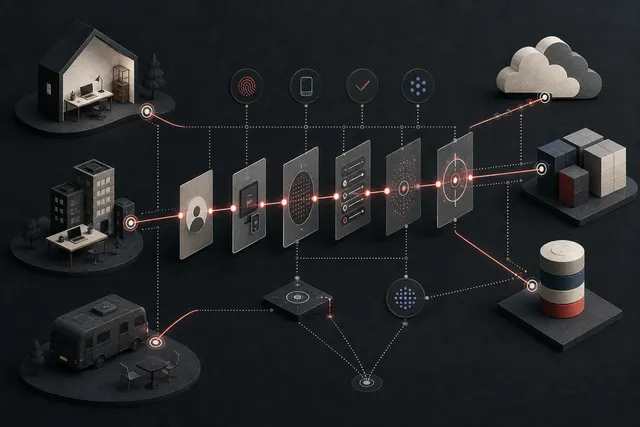
Zero trust is not a product and it is not a rule that every employee must repeatedly prove they are innocent. It is an access architecture that avoids granting broad, lasting trust merely because a person or device is inside a network, belongs to the company, or authenticated once.
For a distributed team, the practical goal is straightforward: make each important access decision from verified identity, device, resource, and risk information; grant only the required authority; and preserve enough evidence to revoke and recover quickly.
That can begin with ordinary controls. A small organization does not need to replace its entire technology stack before it can remove dangerous implicit trust.
Protect resources, not an office perimeter
The old perimeter model assumed that work inside a corporate network was relatively trusted. Distributed teams use cloud applications, personal and managed networks, contractors, mobile devices, and services spread across providers. A VPN can encrypt a connection, but network entry should not become a passport to every internal resource.
NIST SP 800-207 defines zero trust around users, assets, and resources rather than static network location. It states that neither network location nor asset ownership should create implicit trust, and that authentication and authorization occur before a session to a resource is established.
This changes the design question. Instead of asking “who is on the internal network?”, ask:
- who or what is requesting access;
- which exact resource and action are requested;
- whether the device and session meet policy;
- what data and consequences are involved;
- how long the authorization should last;
- what evidence will reveal misuse.
Build the inventory before writing policy
Access control cannot protect resources the organization has not identified. Maintain a versioned inventory of:
- people, contractors, service accounts, and emergency accounts;
- laptops, phones, servers, build runners, and unmanaged devices;
- email, source control, cloud consoles, file storage, finance, HR, support, and production systems;
- sensitive datasets, secrets, signing keys, and backups;
- external integrations and machine-to-machine credentials;
- resource owners and the process for granting and removing access.
The CISA Cross-Sector Cybersecurity Performance Goals are designed as a prioritized baseline and include measurable actions across governance, identification, protection, detection, response, and recovery. Their inventory emphasis is especially important for smaller teams: unmanaged assets and forgotten accounts defeat otherwise strong identity controls.
Classify resources by impact. Losing access to a public documentation tool is different from exposing payroll, customer data, signing keys, or production administration. Stronger resources should require stronger authentication, managed devices, narrower roles, shorter sessions, and more detailed logging.
Establish one authoritative identity lifecycle
Use a central identity provider where practical and connect applications through federation rather than creating independent passwords everywhere. The identity system should reflect employment or contract status, team, role, and high-risk responsibilities.
Define an explicit lifecycle:
- A named owner approves access for a stated job need.
- The user enrolls an approved authenticator and recovery method.
- Applications receive groups or roles, not manually copied entitlements.
- Role changes trigger an access review.
- Departure disables sessions, tokens, keys, and downstream accounts promptly.
- Periodic review removes access that is no longer justified.
Shared accounts erase accountability. Replace them with individual identities and role-based access. When a legacy service cannot avoid a shared credential, store it in an audited secrets system, limit who can retrieve it, rotate it after use or membership changes, and prioritize replacement.
Service identities need the same discipline. Give each workload a distinct identity, narrowly scoped permissions, an owner, an expiration or review date, and a revocation procedure. Do not reuse one permanent API key across development, automation, and production.
Require phishing-resistant authentication where it matters
Passwords remain vulnerable to reuse, theft, and phishing. Require multifactor authentication for email, source control, cloud administration, password management, finance, remote access, and every privileged account.
Not all MFA offers the same protection. CISA’s MFA guidance for organizations recommends aiming for phishing-resistant methods. NIST’s current Digital Identity Guidelines provide requirements for identity proofing, authentication, federation, and authenticator management.
Prefer FIDO/WebAuthn security keys or properly managed passkeys for high-value access. Maintain at least two enrolled authenticators or a controlled recovery process so that stronger authentication does not create an unsafe help-desk bypass.
Recovery is part of authentication security. Verify recovery requests through a channel and evidence independent of the lost factor. Log recovery, notify the user, revoke old authenticators, and apply a temporary restriction to especially sensitive actions when risk warrants it.
Make device state part of access
An authenticated person using a compromised device can still expose data. For sensitive resources, evaluate whether the device is known and meets a minimum posture:
- supported operating system and timely security updates;
- full-disk encryption;
- screen lock and secure local authentication;
- endpoint protection appropriate to the risk;
- no prohibited privilege or security-control changes;
- an ability to remove organizational data when the device is lost or access ends.
Separate “registered” from “healthy.” Registration identifies a device; posture signals whether it still meets policy. Treat posture as evidence with limits, not proof that a device is harmless.
Bring-your-own-device access should reflect the data involved. A personal device may access low-risk communication through a managed browser session while production administration requires a managed workstation. Document the privacy boundary so workers understand what the organization can inspect or erase.
Grant access to an application, not a network
Publish internal applications through an identity-aware access layer where feasible. Authenticate the user and device, evaluate policy, and connect them to the specific application rather than placing the device on a broad internal network.
Segment production, administration, development, and user-facing services. A compromised collaboration account should not automatically reach a database or build system. For machine traffic, use authenticated service identities and explicit resource-to-resource policy rather than trusting an address range.
The goal is not to eliminate networks or firewalls. They remain useful layers. The change is that being connected to a particular network is no longer sufficient authorization.
Use least privilege that expires
Broad permanent administrator roles are convenient until an account is compromised. Establish normal accounts for routine work and separate privileged elevation for exceptional tasks.
Good privileged access has:
- a defined role and resource scope;
- approval proportional to the action;
- a short duration;
- stronger authentication and device requirements;
- session and action logging;
- automatic removal when the window closes.
Avoid role explosion. Begin with a small number of understandable job roles and add resource-specific exceptions only when needed. Review direct user grants because they often survive role changes.
For production changes, separate proposing, approving, and applying the change when the impact justifies it. Emergency access should be possible, but it should be rare, strongly authenticated, immediately visible, and reviewed afterward.
Move secrets out of messages and source code
A distributed team naturally shares information through chat, tickets, documents, and repositories. None of those should become an informal secrets manager.
Use an approved system for credentials and signing material. Prefer short-lived, workload-issued credentials over static keys. Scope secrets by environment and purpose, prevent production values from entering development or CI logs, and rotate them automatically where possible.
Scan repositories and build output for exposed secrets, but do not rely on scanning alone. If a secret is committed or pasted into an untrusted location, revoke it; deleting the visible text does not remove copies from history, caches, logs, or notifications.
Log decisions, not just connections
Zero trust depends on evidence. Centralize enough logs to reconstruct:
- identity authentication and recovery;
- device registration and posture changes;
- access grants, denials, and privilege elevation;
- application and administrative actions;
- secrets access and key rotation;
- changes to policies, groups, and integrations;
- unusual downloads, destinations, and failed attempts.
Protect logs from the same identities they monitor, synchronize time, define retention, and limit sensitive log content. Alert on events with a clear response: impossible or unusual access, new authenticators, mass downloads, disabled controls, unexpected privilege, and dormant accounts returning to use.
Logging everything without ownership produces noise. Assign who receives an alert, how quickly it must be assessed, and which containment actions are authorized.
Design offboarding and incident response together
Offboarding is a routine test of the entire access model. A reliable process should disable the central identity, revoke active sessions and tokens, remove device access, rotate shared or exposed credentials, transfer resource ownership, and preserve required records.
Incident response uses many of the same mechanisms. NIST SP 800-61 Revision 3 integrates preparation, detection, response, and recovery into broader cybersecurity risk management. For a distributed team, rehearse at least account takeover, lost device, leaked token, malicious integration, and compromised administrator scenarios.
The exercise should prove that the team can identify affected resources, revoke access without waiting for every provider, preserve evidence, communicate through an alternate channel, and restore essential work.
A staged implementation order
Trying to buy a complete zero-trust platform first often leaves basic identity problems untouched. A practical sequence is:
- Inventory identities, devices, applications, sensitive data, and owners.
- Centralize identity and automate joiner, mover, and leaver events.
- Enforce strong MFA, beginning with email and privileged systems.
- Remove shared and dormant accounts; separate privileged access.
- Require managed-device posture for sensitive resources.
- Replace broad network access with application-level access.
- Move secrets into managed storage and shorten credential lifetimes.
- Centralize high-value audit events and attach response procedures.
- Test offboarding, account takeover, and recovery.
- Use observed denials, incidents, and exceptions to refine policy.
CISA’s published Zero Trust Maturity Model resources organize progress across identity, devices, networks, applications and workloads, and data, with visibility, analytics, automation, and governance spanning them. A maturity model is a roadmap, not a requirement to implement every advanced feature at once.
What success looks like
A distributed team has a credible baseline when it can answer these questions quickly:
- Who has access to this resource, and why?
- Which identity and device performed this action?
- Would the same request be allowed from an unmanaged or abnormal session?
- Can privileged access expire automatically?
- Can one compromised account reach unrelated systems?
- Can a leaked credential be revoked without a broad outage?
- Can the team reconstruct and contain an incident?
- Does offboarding remove every relevant path, including integrations and tokens?
Zero trust is not achieved by adding friction to every click. It is achieved by replacing hidden, broad, permanent trust with explicit, narrow, observable decisions—and by proving that those decisions can be changed when people, devices, and risks change.